1,830 posters, 67 videos, 75 audios, 29 topics, 22 sessions, 4,727 authors, 1,697 institutions
ePostersLive by SciGen Technologies S.A. All rights reserved.
RCOG World Congress 2023
June 12 - 14, 2023 | London, UK

EP.1650
Primary emergency caesarean section Audit at Tawam Hospital, UAE
Poster Presenter
Authors
Anila Aravindan, Khansaa Warwar, Sadia Solaiman, Uzma Aziz, Omaema Al-Baghdadi, Hanaa Khayoun
Affiliations
Part of Topic
Quality Improvement
Introduction:
Primary caesarean section is defined as caesarean deliveries in women without a prior history of cesarean deliveries. The rate of cesarean section is increasing steadily during the last two decades due to various indications
Keywords: Primary cesarean, Emergency cesarean, cesarean section , fetal distress, failure to progress
Objectives:
To identify the most common indication and outcomes to minimize the number of primary emergency cesarean delivery at Tawam Hospital. To place the necessary actions to achieve optimal care without affecting neonatal outcomes. JAWDA KPI for primary emergency cesarean section rate of ≤12%.
Methods:
A retrospective study was conducted over a period of six months from 1st of January to 30th June 2021 at Tawam Hospital, UAE. Data was retrieved from electronic medical record using Cerner. Data was entered in excel sheet and analysis was done. All primary emergency cesarean section was analyzed during the reporting period. We excluded abnormal presentation, preterm labour with preterm delivery, fetal death, multiple gestations.
Results and Discussion:
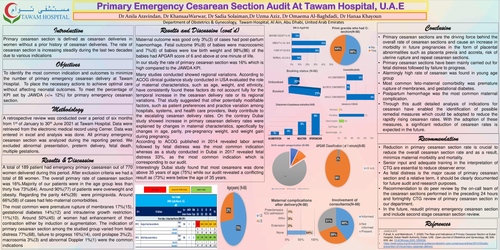
A total of 189 patient had emergency primary caesarean out of 770 women delivered during this period. After exclusion criteria we had a total of 88 women. The overall primary rate of cesarean section was 16%. The majority of our patients were in the age group less than tthirty-five 73%(64). Around 90% (77) of patients were overweight and obese. Regarding the parity 44%(39) were primigravida. Around 66%(58) of cases had feto-maternal comorbidities. The most common were premature rupture of membranes,17% (15), gestational diabetes 14% (12) and intrauterine growth restriction 11% (10). Around 50% (45) of women had enhancement of their contraction either by induction or augmentation. The indication of primcesareanrean section among the studied group varied from fetal distress 77 %(68), failure to progress 16% (14), cord prolapse 3%(2), macrosomia 3% (3) and abnormal Doppler 1% (1) were the common indications.
The maternal outcome was good only 3% (3) of cases had a post-partum haemorrhage. Fetal outcome 9%(8) of babies were macrocosmic and 7% (6) of babies were low birth weight 7% (6) of babies were low birth weight and 98%Most
babies (90.4%) were delivered alive and 49 (33.6%) had APGAR scores of 7 and above.
98% (86) of the babies had APGAR score of 6 and above at one minute of life.
In our study the rate of primary cesarean section was 16 which is high compared to the JAWDA KPI.
Conclusion:
Primary cesarean sections have been mainly carried out for fetal distress being the most common indication followed by failure to progress. Senior input and adequate training in the interpretation of CTG is essential to reduce the observer error. Reduction in the primary cesarean section rate is crucial to reduce the overall cesarean section rate and as a result, minimize in maternal morbidity and mortality.