1,830 posters, 67 videos, 75 audios, 29 topics, 22 sessions, 4,727 authors, 1,697 institutions
ePostersLive by SciGen Technologies S.A. All rights reserved.
RCOG World Congress 2023
June 12 - 14, 2023 | London, UK

EP.1615
Updating Recurrent Miscarriage Management at Great Western Hospital: A Quality Improvement Project
Poster Presenter
Part of Topic
Quality Improvement
UPDATING RECURRENT MISCARRIAGE MANAGEMENT AT GREAT WESTERN HOSPITAL:
A QUALITY IMPROVEMENT PROJECT
MR SAHIN OCAKKURAN, MISS SARA ZAIDI, MRSULEYMAN ULLAH, MRKEVIN JONES
DEPARTMENT OF OBSTETRICS AND GYNAECOLOGY, GREAT WESTERN HOSPITAL NHS TRUST
Introduction:
Approximately 1% of women in the UK experience recurrent miscarriage1. Currently, GWH investigate women with three or more consecutive miscarriages, and no products of conception are sent for chromosomal analysis. This is in contrast to 2011 and 2023 RCOG guidelines, the latter of which advocates for referral after two miscarriage.
Aim:
The aim of this project was to reform the management of recurrent miscarriage (RM) at Great Western Hospital (GWH) to adhere to the Royal College of Obstetricians and Gynaecology (RCOG) guidelines over an 18-week period.
Methods:
A retrospective audit was performed of all patients (n=122) who presented to the Early Pregnancy Unit (EPU) with a miscarriage over the course of July and August 2022. An extensive search of both paper and electronic patient records was conducted to determine gravidity and parity status of each patient. Using this data, the additional number of clinics which would need to be run to accept additional referrals under the RCOG guidelines, were calculated.
Results:
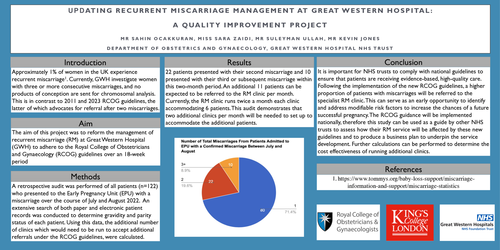
22 patients presented with their second miscarriage and 10 presented with their third or subsequent miscarriage within this two-month period. An additional 11 patients can be expected to be referred to the RM clinic per month. Currently, the RM clinic runs twice a month each clinic accommodating 6 patients. This audit demonstrates that two additional clinics per month will be needed to set up to accommodate the additional patients.
Conclusion:
It is important for NHS trusts to comply with national guidelines to ensure that patients are receiving evidence-based, high-quality care. Following the implementation of the new RCOG guidelines, a higher proportion of patients with miscarriages will be referred to the specialist RM clinic. This can serve as an early opportunity to identify and address modifiable risk factors to increase the chances of a future successful pregnancy. The RCOG guidance will be implemented nationally, therefore this study can be used as a guide by other NHS trusts to assess how their RM service will be affected by these new guidelines and to produce a business plan to underpin the service development. Further calculations can be performed to determine the cost effectiveness of running additional clinics.
References:
1. https://www.tommys.org/baby-loss-support/miscarriage-information-and-support/miscarriage-statistics