1,830 posters, 67 videos, 75 audios, 29 topics, 22 sessions, 4,727 authors, 1,697 institutions
ePostersLive by SciGen Technologies S.A. All rights reserved.
RCOG World Congress 2023
June 12 - 14, 2023 | London, UK

EP.1587
Clinical Profiles of Filipino Women Who Underwent Primary Caesarean Section
Poster Presenter
Authors
Affiliations
Part of Topic
Quality Improvement
Clinical, Demographic, and Labor Profiles of Filipino Women Who Underwent Primary Caesarean Section Compared to Those Who Delivered Vaginally In a Tertiary Medical Center in the Philippines
Nina Angelica G. Kiat, MD, and Maria Regina P. Manahan, MD, FPOGS, FPSUOG, FPSGE
INTRODUCTION
In 2008 the World Health Organization reported that the caesarean section rate increased by 46% in major parts of the world, with a 50% increase of non-indicated caesarean deliveries done in China and Brazil alone. The study aims to provide a detailed description of the clinical, demographic, and labor profiles of Filipino women who underwent a Primary Caesarean Section and those who underwent a vaginal delivery in a Tertiary Medical Center in the Philippines
STUDY DESIGN
This is a retrospective, analytical, and cross-sectional research study conducted at the Makati Medical Center, a hospital in the Philippines where general and high-risk obstetric cases are managed.
METHODOLOGY
The sample size calculated based on a level of significance of 5% and a power of 80% was 1712 subjects. Data of women who underwent spontaneous vertex delivery and primary caesarean section were recorded based on age, body mass index, age of gestation, gravidity and parity, and the presence of comorbidities. The frequencies of primary CS and spontaneous vaginal delivery encountered prior to and during the SARS-CoV2 pandemic and the clinical outcomes were obtained. The indication for each CS case was identified.
RESULTS
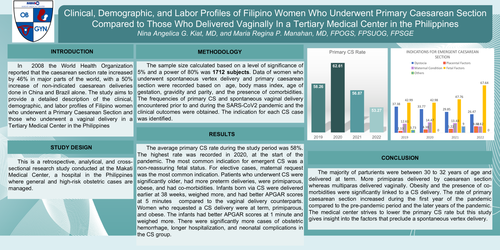
The average primary CS rate during the study period was 58%. The highest rate was recorded in 2020, at the start of the pandemic. The most common indication for emergent CS was a non-reassuring fetal status. For elective cases, maternal request was the most common indication. Patients who underwent CS were significantly older, had more preterm deliveries, were primiparous, obese, and had co-morbidities. Infants born via CS were delivered earlier at 38 weeks, weighed more, and had better APGAR scores at 5 minutes compared to the vaginal delivery counterparts. Women who requested a CS delivery were at term, primiparous, and obese. The infants had better APGAR scores at 1 minute and weighed more. There were significantly more cases of obstetric hemorrhage, longer hospitalization, and neonatal complications in the CS group
CONCLUSION
The majority of parturientswere between 30 to 32 years of age and delivered at term. More primiparas delivered by caesarean section whereas multiparas delivered vaginally. Obesity and the presence of co-morbidities were significantly linked to a CS delivery. The rate of primary caesarean section increased during the first year of the pandemic compared to the pre-pandemic period and the later years of the pandemic. The medical center strives to lower the primary CS rate but this study gives insight into the factors that preclude a spontaneous vertex delivery