1,830 posters, 67 videos, 75 audios, 29 topics, 22 sessions, 4,727 authors, 1,697 institutions
ePostersLive by SciGen Technologies S.A. All rights reserved.
RCOG World Congress 2023
June 12 - 14, 2023 | London, UK

EP.1557
The difficulties in diagnosing a uterine artery malformation
Poster Presenter
Authors
Amelia Gruber, Victoria Minns, Oudai Ali, Sangeetha Devarajan
Affiliations
Part of Topic
Imaging in Gynaecology
Abstract
Title: The difficulties in diagnosing a uterine artery malformation following surgical management of miscarriage – A case report
Objective:
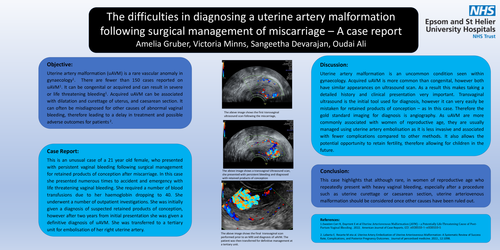
Uterine artery malformation (uAVM) is a rare vascular anomaly in gynaecology.1 There are fewer than 150 cases reported on uAVM.1 It can be congenital or acquired and can result in severe or life threatening bleeding.1 Acquired uAVM can be associated with dilatation and curettage of uterus, and caesarean section. It can often be misdiagnosed for other causes of abnormal vaginal bleeding, therefore leading to a delay in treatment and possible adverse outcomes for patients.2
Case Report:
This is an unusual case of a 21 year old female, who presented with persistent vaginal bleeding following surgical management for retained products of conception after miscarriage. In this case she presented numerous times to accident and emergency with life threatening vaginal bleeding. She required a number of blood transfusions due to her haemoglobin dropping to 40. She underwent a number of outpatient investigations. She was initially given a diagnosis of suspected retained products of conception, however after two years from initial presentation she was given a definitive diagnosis of uAVM. She was transferred to a tertiary unit for embolisation of her right uterine artery.
Discussion:
Uterine artery malformation is an uncommon condition seen within gynaecology. Acquired uAVM is more common than congenital, however both have similar appearances on ultrasound scan. As a result this makes taking a detailed history and clinical presentation very important. Transvaginal ultrasound is the initial tool used for diagnosis, however it can very easily be mistaken for retained products of conception – as In this case. Therefore the gold standard imaging for diagnosis is angiography. As uAVM are more commonly associated with women of reproductive age, they are usually managed using uterine artery embolisation as it is less invasive and associated with fewer complications compared to other methods. It also allows the potential opportunity to retain fertility, therefore allowing for children in the future.
Conclusion:
This case highlights that although rare, in women of reproductive age who repeatedly present with heavy vaginal bleeding, especially after a procedure such as uterine curettage or caesarean section, uterine arteriovenous malformation should be considered once other causes have been ruled out.