1,830 posters, 67 videos, 75 audios, 29 topics, 22 sessions, 4,727 authors, 1,697 institutions
ePostersLive by SciGen Technologies S.A. All rights reserved.
RCOG World Congress 2023
June 12 - 14, 2023 | London, UK

EP.0154
Evaluating implementation of an elective caesarean section (ELCS) enhanced recovery pathway (ERP)
Poster Presenter
Part of Topic
Quality Improvement
Evaluating implementation of an elective caesarean section (ELCS) enhanced recovery pathway (ERP)
Dr Josephine Cooper1, Dr Alexandra Calvia1, Dr Azin Darvihshi1, Dr Chidimma Kanu1, Dr Melissa Kitching1
1. Lister Hospital, East and North Hertfordshire NHS Trust
Objective
Evaluate the East and North Hertfordshire NHS Trust’s ELCS ERP guidelines for adherence, barriers to implementation, and areas for improvement.
Background
An ELCS ERP reflects the commitment RCOG made at the 2012/13 Enhanced Recovery Summit[1]; promoting quicker recovery, shorter hospital stay, and no readmission increase. ERP optimisation can enhance department capacity and flow, as well as improve pregnant persons’ psychosocial and postnatal experience, and reduce maternal and neonatal nosocomial infection risk[2].
Design
A retrospective audit of ELCS ERP deliveries from August 1st-October 1st 2022, results were then compared to 2018 & 2019 audit results.
Guideline standards assessed were:
1)Documented patient information, team discussions and decisions.
2)ELCS timing, catheter removal, and post-op mobilisation.
3)Patient administration of analgesia.
4)Admission length and delay.
5)Removal and monitoring of continuing suitability as per ERP inclusion/exclusion criteria.
6)Theatre to take out (TTO) completion and Recovery intravenous (IV) access removal (introduced from 2019 and 2022 audits, respectively).
Methods
•A CMIS search to identify ELCS cases within our period of interest.
•Paper maternity notes requested and reviewed to identify 36 ERP cases.
•Theatre lists and team brief documents reviewed for each case.
•Microsoft Excel to record & analyse data.
Results
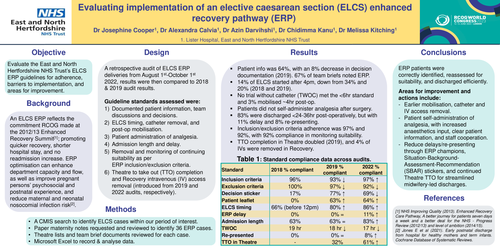
§Patient info was 64%, with an 8% decrease in decision documentation (2019). 67% of team briefs noted ERP.
§14% of ELCS started after 4pm, down from 34% and 20% (2018 and 2019).
§No trial without catheter (TWOC) met the <6hr standard and 3% mobilised ~4hr post-op.
§Patients did not self-administer analgesia after surgery.
§83% were discharged <24-36hr post-operatively, but with 11% delay and 8% re-presenting.
§Inclusion/exclusion criteria adherence was 97% and 92%, with 92% compliance in monitoring suitability.
§TTO completion in Theatre doubled (2019), and 4% of IVs were removed in Recovery.
Table 1: Standard compliance data across audits.
Conclusions
ERP patients were correctly identified, reassessed for suitability, and discharged efficiently.
Areas for improvement and actions include:
-Earlier mobilisation, catheter and IV access removal.
-Patient self-administration of analgesia, with increased anaesthetics input, clear patient information, and staff cooperation.
-Reduce delays/re-presenting through ERP champions, Situation-Background-Assessment-Recommendation (SBAR) stickers, and continued Theatre TTO for streamlined midwifery-led discharges.
References
1] NHS Improving Quality (2013). Enhanced Recovery Care Pathway, A better journey for patients seven days a week and a better deal for the NHS - Progress Review (2012/13) and level of ambition (2014/15).
[2] Jones E et al (2021). Early postnatal discharge from hospital for healthy mothers and term infants. Cochrane Database of Systematic Reviews