Loading...

1,830 posters, 67 videos, 75 audios, 29 topics, 22 sessions, 4,727 authors, 1,697 institutions

ePostersLive by SciGen Technologies S.A. All rights reserved.

RCOG World Congress 2023

June 12 - 14, 2023 | London, UK

RCOG World Congress 2023 banner

EP.0151

Gender-Based Discrimination and Sexual Harassment within OBGYN Training
Part of Topic

Medical Education

Audio

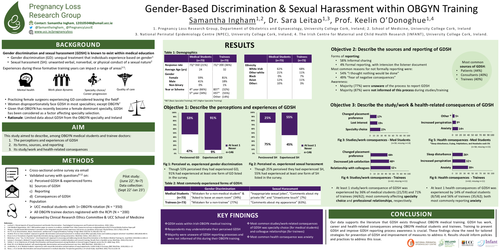
Gender-Based Discrimination & Sexual Harassment within OBGYN Training

Samantha Ingham1,2, Dr. Sara Leitao1,3, Prof. Keelin O’Donoghue1,4

1. Pregnancy Loss Research Group, Department of Obstetrics and Gynaecology, University College Cork, Ireland; 2. School of Medicine, University College Cork, Ireland 3. National Perinatal Epidemiology Centre (NPEC), University College Cork, Ireland; 4. The Irish Centre for Maternal and Child Health Research (INFANT), University College Cork, Ireland.


Background: 

Gender discrimination and sexual harassment (GDSH) is known to exist within medical education. Gender discrimination (GD): unequal treatment that individuals experience based on gender1. Sexual harassment (SH): unwanted verbal, nonverbal, or physical conduct of a sexual nature2. Experiences during these formative training years can impact a range of areas3-5: Mental health, work place dynamic, specialty choice, career progression, quality of care. 

•Practicing female surgeons experiencing GD considered leaving the field6
•Women disproportionately face GDSH in most specialties; except OBGYN7
•Given that OBGYN has recently become a female dominant specialty, GDSH has been considered as a factor affecting specialty selection.
•Rationale: Limited data about GDSH from the OBGYN specialty and Ireland
 
Aims 

This study aimed to describe, among OBGYN medical students and trainee doctors: 

1.The perceptions and experiences of GDSH
2.Its forms, sources, and reporting
3.Its study/work and health-related consequences
 
Methods

•Cross-sectional online survey via email
•Validated survey with questions8-12 on:
a)Perceived GDSH & experienced forms
b)Sources of GDSH
c)Reporting
d)Consequences of GDSH
•Population
- UCC medical students with 1+ OBGYN rotation (N = ~350)
- All OBGYN trainee doctors registered with the RCPI (N = ~200)
•Approved by Clinical Research Ethics Committee & UCC School of Medicine
 
Pilot study:(June 22’; N=7). Data collection:(Sept 22’-Jan 23’). 
 
Key findings:
- GDSH exists within Irish OBGYN medical training
- Respondents may underestimate their perceived GDSH
- Majority were unaware of GDSH reporting processes and were not informed of this during their OBGYN training.
- Most common studies/work-related consequences of GDSH was specialty choice (for medical students) and colleague relationships (for trainees)
- Most common health consequence was anxiety
 
Conclusions 
Our data supports the literature that GDSH exists throughout OBGYN medical training. GDSH has work, career and health-related consequences among OBGYN medical students and trainees. Training to prevent GDSH and improve GDSH reporting process awareness is crucial. These findings show the need for tailored strategies for prevention of GDSH and improvement of measures to address it. Results should inform policies and practices to address this issue.


RCOG World Congress 2023 » banner
Copyright © 2015-2026, ePostersLive® SciGen is a registered trademark of SciGen Technologies S.A. Patent pending.

This website and third-party tools we use rely on cookies for the best user experience. By selecting "I agree", you agree to cookie usage as described in our Privacy Policy.