1,830 posters, 67 videos, 75 audios, 29 topics, 22 sessions, 4,727 authors, 1,697 institutions
ePostersLive by SciGen Technologies S.A. All rights reserved.
RCOG World Congress 2023
June 12 - 14, 2023 | London, UK

EP.1468
Category II (Suspicious) Cardiotocography: A questionable indication for C-section-A hospital-based audit
Poster Presenter
Authors
Affiliations
Part of Topic
Quality Improvement
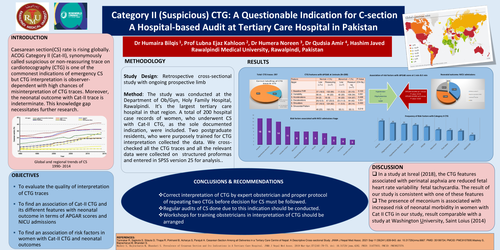
Category II (Suspicious) CTG: A Questionable Indication for C-section A Hospital-based Audit at Tertiary Care Hospital in Pakistan
Dr Humaira Bilqis 1 , Prof Lubna Ejaz Kahloon 2 , Dr Humera Noreen 3 , Dr Qudsia Amir 4 , Hashim Javed Rawalpindi Medical University, Rawalpindi, Pakistan
Corresponding author: Dr. Humaira Bilqis, Assistant Professor Ob/Gyn, Holy Family Hospital, Rawalpindi, Pakistan
Email address: humairabilqis@gmail.com
INTRODUCTION:
Caesarean section(CS) rate is rising globally. ACOG Category II (Cat-II), synonymously called suspicious or non-reassuring trace on cardiotocography (CTG) is one of the commonest indications of emergency CS but CTG interpretation is observerdependent with high chances of misinterpretation of CTG traces. Moreover, the neonatal outcome with Cat-II trace is indeterminate. This knowledge gap necessitates further research.
OBJECTIVES:
To evaluate the quality of interpretation of CTG traces
To find an association of Cat-II CTG and its different features with neonatal outcome in terms of APGAR scores and NICU admissions
To find an association of risk factors in women with Cat-II CTG and neonatal outcomes
METHODOLOGY:
Study Design: Retrospective cross-sectional study with ongoing prospective limb Method: The study was conducted at the Department of Ob/Gyn, Holy Family Hospital, Rawalpindi. It’s the largest tertiary care hospital in that region. A total of 200 hospital case records of women, who underwent CS with Cat-II CTG, as the sole documented indication, were included. Two postgraduate residents, who were purposely trained for CTG interpretation collected the data. We crosschecked all the CTG traces and all the relevant data were collected on structured proformas and entered in SPSS version 25 for analysis.
RESULTS:
Please see the result section in poster figures, tables and graphs.DISCUSSION:
In a study at Isreal (2018), the CTG features associated with perinatal asphxia are reduced fetal heart rate variability fetal tachycardia. The result of our study is consistent with one of these features The presence of meconium is associated with increased risk of neonatal morbidity in women with Cat II CTG in our study, result comparable with a study at Washington University, Saint Loius (2014) REFERENCES: Tamrakar R, Sapkota S, Sitaula D, Thapa R, Pokharel B, Acharya S, Parajuli A. Cesarean Section Among all Deliveries in a Tertiary Care Centre of Nepal: A Descriptive Cross-sectional Study. JNMA J Nepal Med Assoc. 2021 Sep 11;59(241):839-843. doi: 10.31729/jnma.6667. PMID: 35199724; PMCID: PMC9
CONCLUSIONS & RECOMMENDATIONS:
Correct interpretation of CTG by expert obstetrician and proper protocol of repeating two CTGs before decision for CS must be followed. Regular audits of CS done due to this indication should be conducted. Workshops for training obstetricians in interpretation of CTG should be arranged