1,830 posters, 67 videos, 75 audios, 29 topics, 22 sessions, 4,727 authors, 1,697 institutions
ePostersLive by SciGen Technologies S.A. All rights reserved.
RCOG World Congress 2023
June 12 - 14, 2023 | London, UK

EP.1461
PREOPERATIVE RISK ASSESSMENT OF ADNEXAL MASSES USING SIMPLE RULES FROM IOTA GROUP
Poster Presenter
Authors
Affiliations
Part of Topic
Imaging in Gynaecology
PREOPERATIVE RISK ASSESSMENT OF ADNEXAL MASSES USING SIMPLE RULES FROM INTERNATIONAL OVARIAN TUMOR ANALYSIS [IOTA] GROUP
Dr. Kurra Jayasri, Dr. Pendyala Sujata
Introduction:
In gynecological practice, the first investigation done in patients with complaints of pain abdomen or with palpable/ suspected abdominal mass is Ultrasonography.1The subjective evaluation of the findings in an ultrasound is the best method to differentiate between malignant and benign adnexal masses when performed by an ultrasound examiner with sufficient experience.2-3As such experience is difficult to come by, the IOTA study had tried to develop algorithms for diagnosis, which aid physicians in differentiating adnexal pathology, without depending on the expertise of the physician.
Aim of the study :
The aim of this study is to predict the risk of malignancy using ultrasonography in adnexal masses based on the simple rules given by IOTA group and to evaluate the diagnostic performance of IOTA simple rules in differentiating between benign and malignant ovarian tumors and their correlation with histopathological study.
Materials and Methods :
A prospective observational study was conducted in which total of 76 cases were enrolled presenting with adnexal masses, admitted in department of obstetrics and gynaecology, over a period of 1year 6months, after formal written consent.
Inclusion criteria :
• Women who presented with adnexal masses willing for surgery.
✓ In case of bilateral adnexal masses, we include the mass with the most complex ultrasonic morphology.
✓ If both the masses have similar ultrasonic morphology, we include the largest one or the one most easily accessible by Trans abdominal/Trans vaginal ultrasound.
• Patients who have given informed consent
Exclusion criteria :
• Pregnancy at the time of examination.
• Refusal for USG
• Surgical intervention >120 days after the ultrasound examination
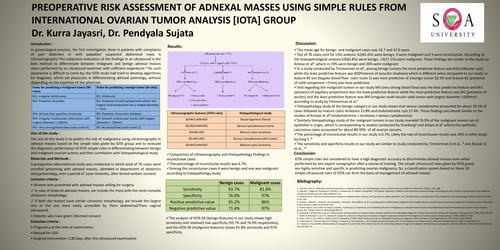
Results:
Conclusion:
IOTA simple rules are considered to have a high diagnostic accuracy to discriminate adnexal masses even when performed by non-expert sonographer after a course of training. The simple ultrasound rules given by IOTA group are highly sensitive and specific in predicting ovarian malignancy. So, a classification system based on these 10 simple ultrasound rules of IOTA can form the basis of management of adnexal masses.