1,830 posters, 67 videos, 75 audios, 29 topics, 22 sessions, 4,727 authors, 1,697 institutions
ePostersLive by SciGen Technologies S.A. All rights reserved.
RCOG World Congress 2023
June 12 - 14, 2023 | London, UK

EP.1433
Analysis of Umbilical Paired Cord Blood Gas at the time of Delivery
Poster Presenter
Authors
Affiliations
Part of Topic
Quality Improvement
Analysis of Umbilical Paired Cord Blood Gas at the time of Delivery
Jebin Nourin, Trust Doctor, Obstetrics & Gynaecology, Queen Alexandra Hospital, Portsmouth Hospitals University NHS Trust
Vaithilingam Nirmala, Consultant in Obstetrics & Gynaecology, Queen Alexandra Hospital, Portsmouth Hospitals University NHS Trust
Objective: To analyze the compliance of Paired Cord Gas Analysis at the time of delivery in high-risk mother and baby.
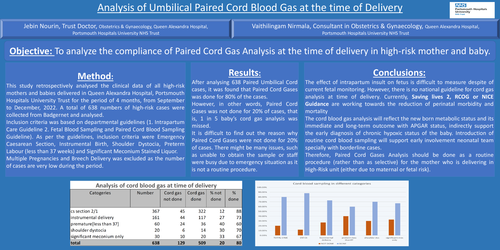
Method: This study retrospectively analysed the clinical data of all high-risk mothers and babies delivered in Queen Alexandra Hospital, Portsmouth Hospitals University Trust for the period of 4 months, from September to December, 2022. A total of 638 numbers of high-risk cases were collected from Badgernet and analysed. Inclusion criteria was based on departmental guidelines (1. Intrapartum Care Guideline 2. Fetal Blood Sampling and Paired Cord Blood Sampling Guideline). As per the guidelines, inclusion criteria were Emergency Caesarean Section, Instrumental Birth, Shoulder Dystocia, Preterm Labour (less than 37 weeks) and Significant Meconium Stained Liquor. Multiple Pregnancies and Breech Delivery was excluded as the number of cases are very low during the period. Analysis of Umbilical Paired Cord Blood Gas at the time of Delivery Jebin Nourin, Trust Doctor, Obstetrics & Gynaecology, Queen Alexandra Hospital, Portsmouth Hospitals University NHS Trust Vaithilingam Nirmala, Consultant in Obstetrics & Gynaecology, Queen Alexandra Hospital, Portsmouth Hospitals University NHS Trust Objective: To analyze the compliance of Paired Cord Gas Analysis at the time of delivery in high-risk mother and baby.
Results: After analysing 638 Paired Umbilical Cord cases, it was found that Paired Cord Gases was done for 80% of the cases. However, in other words, Paired Cord Gases was not done for 20% of cases, that is, 1 in 5 baby’s cord gas analysis was missed. It is difficult to find out the reason why Paired Cord Gases were not done for 20% of cases. There might be many issues, such as unable to obtain the sample or staff were busy due to emergency situation as it is not a routine procedure.
Conclusions: The effect of intrapartum insult on fetus is difficult to measure despite of current fetal monitoring. However, there is no national guideline for cord gas analysis at time of delivery. Currently, Saving lives 2, RCOG or NICE Guidance are working towards the reduction of perinatal morbidity and mortality The cord blood gas analysis will reflect the new born metabolic status and its immediate and long-term outcome with APGAR status, indirectly support the early diagnosis of chronic hypoxic status of the baby. Introduction of routine cord blood sampling will support early involvement neonatal team specially with borderline cases. Therefore, Paired Cord Gases Analysis should be done as a routine procedure (rather than as selective) for the mother who is delivering in High-Risk unit (either due to maternal or fetal risk)