1,830 posters, 67 videos, 75 audios, 29 topics, 22 sessions, 4,727 authors, 1,697 institutions
ePostersLive by SciGen Technologies S.A. All rights reserved.
RCOG World Congress 2023
June 12 - 14, 2023 | London, UK

EP.1431
Stronger together. A model for sharing health-risk data to prevent healthcare failure.
Poster Presenter
Part of Topic
Quality Improvement
Stronger together. A model for sharing health-risk data to prevent healthcare failure.
Dr Benjamin M Nowotny1,2,3, Dr Miranda Davies-Tuck2,3, Prof Euan M Wallace2,3,4
1 Monash Health, Melbourne AUS; 2 Monash University, Melbourne AUS; 3 Ritchie Centre, Melbourne AUS; 4 Department of Health & Human Services, Melbourne AUS
Objective
Recommendations from a recent report on quality and safety weaknesses in the Australian state of Victoria’s hospital system highlighted that key agencies involved in healthcare provision share safety intelligence. For continued safety improvement at a system level, collaborative data sharing must be explored as a means of predicting safety breaches. Our target was to assess whether collating all available data feeds for this high-profile maternity service failure could have enabled earlier identification. This presentation aims to review the successes and challenges in developing a large data-sharing model to identify critical healthcare safety risks.
Design
Observational Descriptive Study
Methods
Quality and safety data were obtained from six organisations between 2000-16 and collated in a linked dataset. Annual event counts were assessed for legal claims and complaints. Annual event rates were calculated for emergency neonatal and perinatal transfers. Perinatal mortality was expressed as a rate. Birth numbers were expressed as a rate of births per birth suite room annually for all maternity units in the state.
Results
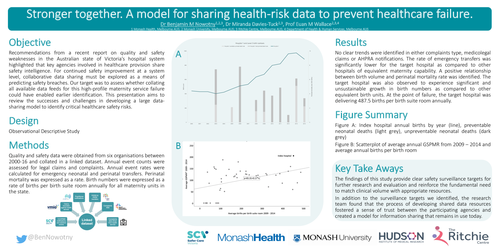
No clear trends were identified in either complaints type, medicolegal claims or AHPRA notifications. The rate of emergency transfers was significantly lower for the target hospital as compared to other hospitals of equivalent maternity capability. A positive relationship between birth volume and perinatal mortality rate was identified. The target hospital was also observed to experience significant and unsustainable growth in birth numbers as compared to other equivalent birth units. At the point of failure, the target hospital was delivering 487.5 births per birth suite room annually.
Key Take Aways
The findings of this study provide clear safety surveillance targets for further research and evaluation and reinforce the fundamental need to match clinical volume with appropriate resources.
In addition to the surveillance targets we identified, the research team found that the process of developing shared data resources fostered a sense of trust between the participating agencies and created a model for information sharing that remains in use today.