1,830 posters, 67 videos, 75 audios, 29 topics, 22 sessions, 4,727 authors, 1,697 institutions
ePostersLive by SciGen Technologies S.A. All rights reserved.
RCOG World Congress 2023
June 12 - 14, 2023 | London, UK

EP.1427
Retrospective Audit of Iron Infusion for Iron Deficiency Anaemia in Pregnancy
Poster Presenter
Authors
Affiliations
Part of Topic
Quality Improvement
Objective:
Moderate to severe iron deficiency anaemia (IDA) during pregnancy and at time of delivery has been linked to adverse offspring neurodevelopment, preterm birth, post-partum haemorrhage, and post-partum blood product transfusion.(1) It is recommended that women diagnosed with IDA be treated with an oral iron supplement, and for consideration of intravenous iron for women who have failed to respond to oral therapy, are intolerant, or are non-compliant.(2) The aim of this audit was to determine the accuracy of the diagnosis of IDA in pregnancy by clinicians, and adherence to recommended guidelines when referring pregnant women for an iron infusion at Liverpool Hospital, Sydney Australia.
Design:
A quality assurance study was used to evaluate current health referral practices and to identify if the recommended clinical guideline(2) is adhered to.
Methods:
A retrospective clinical audit of all pregnant women greater than 20 weeks gestation diagnosed with IDA and referred to a metropolitan tertiary hospital outpatient department for an iron infusion between July 2022 and November 2022 was performed. Forty study participants were identified by reviewing all referrals of pregnant women for iron infusions within this time period. The medical record of participants was then reviewed to determine if participants met the diagnosis of iron deficiency anaemia in pregnancy at time of referral, if a period of oral iron supplementation was trialled prior to referral, and haemoglobin at diagnosis and time of delivery. A diagnosis of iron deficiency anaemia in pregnancy was defined as haemoglobin less than 110 grams per litre (g/L) and ferritin of less than or equal to 30 micrograms per litre.(2)
Results:
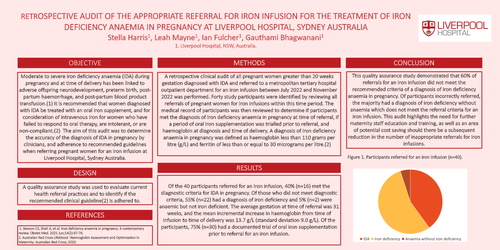
Of the 40 participants referred for an iron infusion, 40% (n=16) met the diagnostic criteria for IDA in pregnancy. Of those who did not meet diagnostic criteria, 55% (n=22) had a diagnosis of iron deficiency and 5% (n=2) were anaemic but not iron deficient. The average gestation at time of referral was 31 weeks, and the mean incremental increase in haemoglobin from time of infusion to time of delivery was 13.7 g/L (standard deviation 9.0 g/L). Of the participants, 75% (n=30) had a documented trial of oral iron supplementation prior to referral for an iron infusion.
Conclusion:
This quality assurance study demonstrated that 60% of referrals for an iron infusion did not meet the recommended criteria of a diagnosis of iron deficiency anaemia in pregnancy. Of participants incorrectly referred, the majority had a diagnosis of iron deficiency without anaemia which does not meet the referral criteria for an iron infusion. This audit highlights the need for further maternity staff education and training, as well as an area of potential cost saving should there be a subsequent reduction in the number of inappropriate referrals for iron infusions.