1,830 posters, 67 videos, 75 audios, 29 topics, 22 sessions, 4,727 authors, 1,697 institutions
ePostersLive by SciGen Technologies S.A. All rights reserved.
RCOG World Congress 2023
June 12 - 14, 2023 | London, UK

EP.0136
Intracorporeal vs. extracorporeal suturing techniques in laparoscopy: A randomized, controlled study
Poster Presenter
Authors
Kathrin Labrosse, Claudia Marinho, Bernhard Fellmann-Fischer, Franziska Geissler, Andreas Schötzau, Viola Heinzelmann-Schwarz, Tibor Zwimpfer
Affiliations
Department of Gynecological Oncology, University Hospital Basel, Medical Faculty, University Basel, Department of Biomedicine, University Basel and University Hospital Basel
Part of Topic
Medical Education
Intracorporeal vs. extracorporeal open and closed suturing techniques in laparoscopy:A randomized, controlled study
Dr. Kathrin Labrosse*1, Claudia Marinho*3, Dr. Bernhard Fellmann-Fischer2, Franziska Geissler1, Andreas Schötzau2, Prof. Viola Heinzelmann-Schwarz 1,2, Dr. Tibor Zwimpfer1,2
*contributed equally
1) Department of Gynecological Oncology, University Hospital Basel, 4031 Basel, Switzerland
2) Department of Biomedicine, University Basel and University Hospital Basel, 4031, Basel, Switzerland
3) Medical Faculty, University Basel, 4056 Basel, Switzerland
Background
Suturing is one of the most challenging tasks in laparoscopic surgery. Ensuring both the ease and speed of suturing has benefits not only for the surgeon, but can dramatically decrease operating time. Therefore, this study aimed to compare extracorporeal and intracorporeal suturing techniques using a Szabo pelvic trainer model from the Gynaecological Endoscopic Surgical Education and Assessment program.
Methods
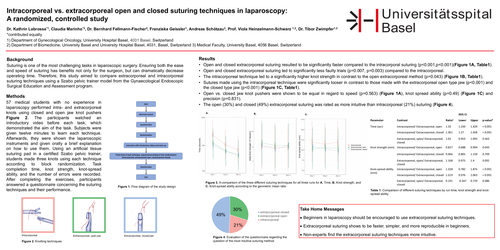
57 medical students with no experience in laparoscopy performed intra- and extracorporeal knots using closed and open jaw knot pushers Figure 2. The participants watched an introductory video before each task, which demonstrated the aim of the task. Subjects were given twelve minutes to learn each technique. Afterwards, they were shown the laparoscopic instruments and given orally a brief explanation on how to use them. Using an artificial tissue suturing pad in a certified Szabo pelvic trainer, students made three knots using each technique according to block randomization. Task completion time, knot strength, knot-spread ability, and the number of errors were recorded. After completing the exercises, participants answered a questionnaire concerning the suturing techniques and their performance.
Results
•Open and closed extracorporeal suturing resulted to be significantly faster compared to the intracorporal suturing (p<0.001,p<0.001)(Figure1A, Table1).
•Open and closed extracorporeal suturing led to significantly less faulty trials (p=0.007, p=0.003) compared to the intracorporeal.
•The intracorporeal technique led to a significantly higher knot strength in contrast to the open extracorporeal method (p=0.043) (Figure 1B, Table1).
•Sutures made using the intracorporeal technique were significantly looser in contrast to those made with the extracorporeal open type jaw (p<0.001) and the closed type jaw (p<0.001) (Figure 1C, Table1).
•Open vs. closed jaw knot pushers were shown to be equal in regard to speed (p=0.563) (Figure 1A), knot spread ability (p=0.49) (Figure 1C) and precision (p=0.831).
•The open (30%) and closed (49%) extracorporeal suturing was rated as more intuitive than intracorporeal (21%) suturing (Figure 4).
Take Home Messages
·Beginners in laparoscopy should be encouraged to use extracorporeal suturing techniques.
·Extracorporeal suturing shows to be faster, simpler, and more reproducible in beginners.
·Non-experts find the extracorporeal suturing techniques more intuitive.