1,830 posters, 67 videos, 75 audios, 29 topics, 22 sessions, 4,727 authors, 1,697 institutions
ePostersLive by SciGen Technologies S.A. All rights reserved.
RCOG World Congress 2023
June 12 - 14, 2023 | London, UK

EP.1370
COITAL INJURY WITH HAEMORRHAGIC SHOCK IN A TEENAGER: CULTURAL CHALLENGES IN DIAGNOSIS
Part of Topic
Sexual Health and Contraception
Consensual Coital Laceration Of The Posterior Vaginal Fornix With Haemorrhagic Shock In A Teenage Girl: Diagnostic And Management Challenges.
. Eze I. O 1 ,Salihu M.J 3 ,Innoeze C. U4 , Elegbua C. O2 , Afolayan S.T 2 , Adaji J.A 5 , Meremikwu C. A
INTRODUCTION
Life threatening injuries can result from consensual coitus. In most parts of Africa where children are raised without adequate sex education, and sex is seen as shameful topic and taboo in extreme cases, coital injuries are unlikely to be reported or may be misdiagnosed and mismanaged. This may result in morbidities and mortalities. Scarcity of data on this subject underscores the need for this case report to create awareness and add to the body of knowledge.
CASE SUMMARY
Patient was a 17-year old student who presented with haemorrhagic shock to the emergency unit of a hospital in Southern Nigeria with a 4 hour history of torrential vaginal bleeding and 2 fainting episodes prior to presentation. In the presence of her parents, she insisted she was having a “heavy menstrual flow”, and denied any sexual activity.
A pregnancy test carried out was negative and her pelvic ultrasound scan ruled out any pregnancy complications. A more tactful, confidential and empathic approach to history taking, done in the absence of parents and chaperone revealed that her presenting symptoms were preceded by consensual coitus.
At presentation, she was conscious but drowsy, sweating with cold extremities, pale looking (urgent PCV was 18%), pulse rate was 120 per minute moderate volume, blood pressure 70/40mmHg, she had 20 breaths per minute, and SPO2 at room air was 95%. Abdominal findings were essentially normal.
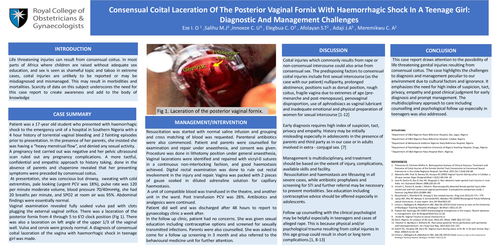
Vaginal examination revealed fully soaked vulva pad with clots plugging the external vaginal orifice. There was a laceration of the posterior fornix from 4 through 5 to 6’O clock position (Fig 1). There was also a laceration on left angle of the upper 1/3 of the vaginal wall. Vulva and cervix were grossly normal. A diagnosis of consensual coital laceration of the vagina with haemorrhagic shock in teenage girl was made.
MANAGEMENT/INTERVENTION
Resuscitation was started with normal saline infusion and grouping and cross matching of blood was requested. Parenteral antibiotics were also commenced. Patient and parents were counselled for examination and repair under anaesthesia, and consent was given. Procedure was done in lithotomy position under general anaesthesia, Vaginal lacerations were identified and repaired with vicryl-0 sutures in a continuous non-interlocking fashion, and good haemostasis achieved. Digital rectal examination was done to rule out rectal involvement in the injury and repair. Vagina was packed with 2 pieces of gauze soaked in diluted adrenaline solution for capillary haemostasis.
A unit of compatible blood was transfused in the theatre, and another unit in the ward. Post transfusion PCV was 28%. Antibiotics and analgesics were continued.
Patient did well and was discharged after 48 hours to report to gynaecology clinic a week after.
In the follow up clinic, patient had no concerns. She was given sexual education including contraceptive options and screened for sexually transmitted infections. Parents were also counselled. She was asked to come for a follow up screening in 3 month and also referred to the behavioural medicine unit for further attention.
DISCUSSION
Coital injuries which commonly results from rape or non-consensual intercourse could also arise from consensual sex. The predisposing factors to consensual coital injuries include first sexual intercourse (as the case with our patient) nulliparity, prolonged abstinence, positions such as dorsal position, rough coitus, fragile vagina due to extremes of age (pre-menarche and post-menopause), penovaginal disproportion, use of aphrodisiacs as vaginal lubricant and inadequate emotional and physical preparation of women for sexual intercourse [1-12]
Early diagnosis requires high index of suspicion, tact, privacy and empathy. History may be initially misleading especially in adolescents in the presence of parents and third party as in our case or in adults involved in extra - conjugal sex. [7]
Management is multidisciplinary, and treatment should be based on the extent of injury, complications, available skills and facility.
Resuscitation and haemostasis are lifesaving in all severe cases, while antibiotic prophylaxis and screening for STI and further referral may be necessary to prevent morbidities. Sex education including contraceptive advice should be offered especially in adolescents.
Follow up counselling with the clinical psychologist may be helpful especially in teenagers and cases of alleged rape. This is because physical and/or psychological trauma resulting from coital injuries in this age group could result in short or long term complications.[1, 8-13]
CONCLUSION
This case report draws attention to the possibility of life threatening genital injuries resulting from consensual coitus. The case highlights the challenges to diagnosis and management peculiar to our environment due to cultural factors and ignorance. It emphasizes the need for high index of suspicion, tact, privacy, empathy and good clinical judgment for early diagnosis and prompt management. The multidisciplinary approach to care including counselling and psychological follow up especially in teenagers was also addressed.