1,830 posters, 67 videos, 75 audios, 29 topics, 22 sessions, 4,727 authors, 1,697 institutions
ePostersLive by SciGen Technologies S.A. All rights reserved.
RCOG World Congress 2023
June 12 - 14, 2023 | London, UK

EP.0135
An Exploratory Study of Obstetrics Trainees’ Experiences of Breaking Bad News
Poster Presenter
Authors
Affiliations
Part of Topic
Medical Education
Video
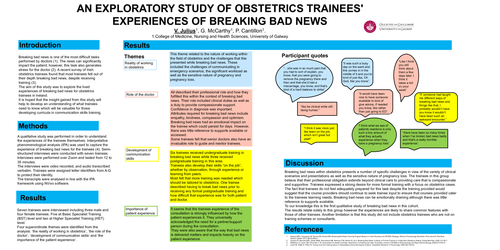
AN EXPLORATORY STUDY OF OBSTETRICS TRAINEES' EXPERIENCES OF BREAKING BAD NEWS
V. Julius1, G. McCarthy1, P. Cantillon1.
1.College of Medicine, Nursing and Health Sciences, University of Galway
Introduction
Breaking bad news is one of the most difficult tasks performed by doctors (1). The news can significantly impact the patient; however, this task also generates stress for the doctor (2). A recent survey of Irish obstetrics trainees found that most trainees felt out of their depth breaking bad news, despite receiving training (3).
The aim of this study was to explore the lived experiences of breaking bad news for obstetrics trainees in Ireland.
It is hoped that the insight gained from this study will help to develop an understanding of what trainees need to know which will be valuable for those developing curricula in communication skills training.
Methods
A qualitative study was performed in order to understand the experiences of the trainees themselves. Interpretative phenomenological analysis (IPA) was used to capture the experience of breaking bad news for the trainees (4). Semi-structured interviews were conducted with seven trainees. Interviews were performed over Zoom and lasted from 12 to 35 minutes.
The interviews were video recorded, and audio transcribed verbatim. Trainees were assigned letter identifiers from A-G to protect their identity.
The transcripts were analysed in line with the IPA framework using NVivo software.
Results
Seven trainees were interviewed including three male and four female trainees. Five at Basic Specialist Training (BST) level and two at Higher Specialist Training (HST) level.
Four superordinate themes were identified from the analysis: ‘the reality of working in obstetrics’, ‘the role of the doctor’, ‘development of communication skills’ and ‘the importance of the patient experience’.
Themes
Reality of working in obstetrics
This theme related to the nature of working within the field of obstetrics and the challenges that this presented while breaking bad news. These included the challenges of communicating in emergency scenarios, the significant workload as well as the sensitive nature of pregnancy and pregnancy loss.
Role of the doctor
All described their professional role and how they fulfilled this within the context of breaking bad news. Their role included clinical duties as well as a duty to provide compassionate support.
Confidence in diagnosis was important.
Attributes required for breaking bad news include empathy, kindness, compassion and optimism.
Breaking bad news had an emotional impact on the trainee which could persist for days. However, there was little reference to supports available or accessed.
Some trainees felt that senior doctors also have an invaluable role to guide and mentor trainees.
Development of communication skills
Six trainees received undergraduate training in breaking bad news while three received postgraduate training in this area.
Trainees also develop their skills “on the job”, whether by observation, through experience or learning from peers.
Most felt that more training was needed which should be tailored to obstetrics. One trainee described having to break bad news prior to receiving any formal postgraduate training and how difficult that experience was for both patient and doctor.
Importance of patient experience
It seems that the trainees experience of the consultation is strongly influenced by how the patient experiences it. They universally acknowledged the need for a partner/support person during the consultation.
They were also aware that the way that bad news is delivered matters and impacts heavily on the patient experience.
Participant quotes
“…she was in so much pain that you had to sort of explain, you know, that you were going to remove the pregnancy there and then and that she’d had a miscarriage, you know, and that’s kind of a hard balance to strike”.
“it was such a busy day on the ward and this comes in in the middle of it and you’re kind of just like, Oh God, like you know”.
“like be clinical while still being human.”
“It would have been nice to have someone available to kind of give advice, if needed you know, like rather than just going to ED”.
“Like I think you still think about them a few days later. I think it takes a toll on your week”
“if someone had taught me different ways of breaking bad news and things like that, I probably wouldn’t have you know it wouldn’t have been such an awkward encounter.”
“I think it was more just like learn on the job, which isn’t great but yeah”
“I think what we see of patients reactions is only such a tiny amount of what they actually experience when they have a pregnancy loss”
“there have been so many times when I’ve broken bad news badly and that’s a really horrible experience”.
Discussion
Breaking bad news within obstetrics presents a number of specific challenges in view of the variety of clinical scenarios and presentations as well as the sensitive nature of pregnancy loss. The trainees in this group believe that their professional obligation extends beyond clinical care to providing care that is compassionate and supportive. Trainees expressed a strong desire for more formal training with a focus on obstetrics cases. The fact that trainees do not feel adequately prepared for this task despite the training provided would suggest that the course providers should continue to seek trainee input to ensure that courses provided cater to the trainees learning needs. Breaking bad news can be emotionally draining although there was little reference to supports available.
To our knowledge this is the first qualitative study of breaking bad news in this cohort.
The results relate solely to this group however the experiences are likely to share common features with those of other trainees. Another limitation is that this study did not include obstetrics trainees who are not on training schemes or consultants.
References