1,830 posters, 67 videos, 75 audios, 29 topics, 22 sessions, 4,727 authors, 1,697 institutions
ePostersLive by SciGen Technologies S.A. All rights reserved.
RCOG World Congress 2023
June 12 - 14, 2023 | London, UK

EP.1304
Antenatal Care in a Public Tertiary Care Hospital – A quality improvement study
Poster Presenter
Authors
Affiliations
Part of Topic
Quality Improvement
Title: Antenatal care in a Tertiary Care Hospital, Pakistan – A Quality Improvement Study
Introduction
The quality of antenatal care(ANC) was previously assessed by the number of antenatal visits but it is no longer accepted as a measure of quality of ANC because it only takes in to account the contact frequency without looking into the content of care actually received during each visit. This study thoroughly investigated each ANC visit to get a true picture of the care received and compared it with the WHO guidelines and correlated it with fetomaternal outcome
Objectives
-
To evaluate the quality of ANC and identify the deficiencies in ANC in our unit
-
To evaluate the relationship of quality of antenatal care with feto-maternal outcome
Methodology
This cross-sectional study was conducted in OB/GYN Unit 1 of Holy Family Hospital (HFH), Rawalpindi, using non-probability convenient sampling to include 400 patients (total 1296 ANC visits) who received ANC & were delivered in HFH. Antenatal records were thoroughly checked and accuracy was verified with face to face interviews, while feto-maternal outcomes were noted from the delivery register. For all identified obstetrical and medical complications, the record was commented on by the consultant to evaluate if it was diagnosed and treated optimally/sub-optimally. Data were entered and analyzed on SPSS-19.
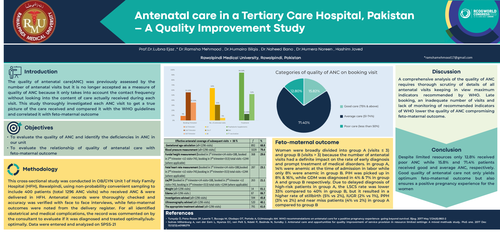
Results of quality of care in tables and bar chart and pei chart
Feto-maternal outcome
Women were broadly divided into group A (visits ≤ 3) and group B (visits > 3) because the number of antenatal visits had a definite impact on the rate of early diagnosis and prompt treatment of medical disorders. In group A, 14% were anemic at the time of admission in labor while only 8% were anemic in group B. PIH was picked up in 8% & 16%, while GDM was diagnosed in 4% & 7% in group A and group B respectively. Due to delayed diagnosis of high-risk patients in group A, the LSCS rate was lower 33% compared to 40% in group B, but it resulted in a higher rate of stillbirth (5% vs 2%), IUGR (2% vs 1%), PPH (3% vs 2%) and near miss patients (4% vs 2%) in group A compared to group B
Discussion
A comprehensive analysis of the quality of ANC requires thorough scrutiny of details of all antenatal visits keeping in view maximum indicators recommended by WHO. Late booking, an inadequate number of visits and lack of monitoring of recommended indicators of WHO lower the quality of ANC compromising feto-maternal outcome.
Conclusion
Despite limited resources only 12.8% received poor ANC while 15.8% and 71.4% patients received good and average ANC, respectively. Good quality of antenatal care not only yields optimum feto-maternal outcome but also ensures a positive pregnancy experience for the women>