1,830 posters, 67 videos, 75 audios, 29 topics, 22 sessions, 4,727 authors, 1,697 institutions
ePostersLive by SciGen Technologies S.A. All rights reserved.
RCOG World Congress 2023
June 12 - 14, 2023 | London, UK

EP.1294
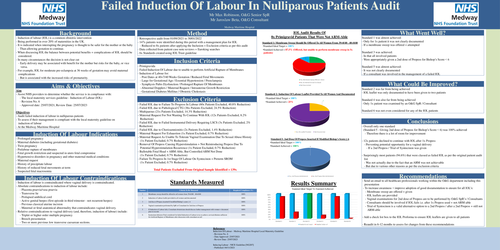
Failed Induction Of Labour In Nulliparous Patients Audit
Poster Presenter
Authors
Affiliations
Part of Topic
Quality Improvement
Failed Induction Of Labour In Nulliparous Patients Audit
Mr Max Robinson, O&G Senior SpR
Mr Jaroslaw Beta, O&G Consultant
Medway Maritime Hospital
Background
- Induction of labour (IOL) is a common obstetric intervention
- Being performed in over 20% of maternities in the UK.
- It is indicated when interrupting the pregnancy is thought to be safer for the mother or the baby
- Than allowing gestation to continue.
- When discussing IOL the balance between potential benefits + complications of IOL should be considered.
- In many circumstances the decision is not clear cut
- Early delivery may be associated with benefit for the mother but risks for the baby, or vice versa.
- For example, IOL for moderate pre-eclampsia at 36 weeks of gestation may avoid maternal complications
- But is associated with the increased risks of prematurity.
Aims & Objectives
Aim
- Assist NHS providers to determine whether the service is in compliance with:
- The local maternity services guideline - Induction of Labour (IOL)
- Revision No. 6
- Approved date: 25/07/2021, Review Date: 25/07/2023
Objectives
- Audit failed induction of labour in nulliparous patients
- To assess if their management is compliant with the local maternity guideline on
induction of labour
- At the Medway Maritime Hospital
Induction Of Labour Indications
- Prolonged pregnancy
- Maternal diabetes (including gestational diabetes)
- Twin pregnancy
- Prelabour rupture of membranes
- Fetal growth restriction and suspected in utero fetal compromise
- Hypertensive disorders in pregnancy and other maternal medical conditions
- Maternal request
- History of precipitate labour
- History of reduced fetal movements at term
- Suspected fetal macrosomia
Induction Of Labour Contraindications
- Induction of labour is contraindicated where vaginal delivery is contraindicated.
- Absolute contraindications to induction of labour include:
- Placenta praevia/vasa praevia
- Transverse lie
- Prolapsed umbilical cord
- Active genital herpes (first episode in third trimester - not recurrent herpes)
- Previous classical uterine incision
- Maternal or fetal anatomical abnormality that contraindicates vaginal delivery.
- Relative contraindications to vaginal delivery (and, therefore, induction of labour) include:
- Triplet or higher order multiple pregnancy
- Breech presentation
- Two or more previous low transverse caesarean sections.
Method
- Retrospective audit from 01/09/2021 to 30/01/2022
- 147x patients were identified during this period with a management plan for IOL
- Reduced to 8x patients after applying the Inclusion + Exclusion criteria as per this audit
- Data collected from patient case note reviews + Euroking searches
- 6x Standards created using IOL Trust guideline
Inclusion Criteria
- Primigravida
- Failed Induction Of Labour due to unable to perform Artificial Rupture of Membranes
- Induction of Labour for:
- Post Dates at 40+7/40 Weeks Gestation / Reduced Fetal Movements
- Large for Gestational Age / Essential Hypertension / Preeclampsia
- Symphysis Pubis Dysfunction / Prolonged Rupture Of Membranes
- Abnormal Dopplers / Maternal Request / Intrauterine Growth Restriction
- Gestational Diabetes Mellitus / Obstetric Cholestasis
Exclusion Criteria
- Failed IOL due to Failure To Progress In Labour (60x Patients Excluded, 40.8% Reduction)
- Failed IOL due to Pathological CTG (36x Patients Excluded, 24.5% Reduction)
- Multiparous (21x Patients Excluded, 14.3% Reduction)
- Maternal Request For Not Wanting To Continue With IOL (12x Patients Excluded, 8.2%
Reduction)
- Failed IOL due to Failed Instrumental Delivery Requiring LSCS (3x Patients Excluded, 2%
Reduction)
- Failed IOL due to Chorioamnionitis (2x Patients Excluded, 1.4% Reduction)
- Maternal Request For Exhaustion (1x Patient Excluded, 0.7% Reduction)
- Maternal Request As Unable To Tolerate Vaginal Examination Due To Sexual Abuse History
(1x Patient Excluded, 0.7% Reduction)
- Removal Of Propess Causing Hyperstimulation + Not Reintroducing Propess Due To
Potential Hyperstimulation Recurrence (1x Patient Excluded, 0.7% Reduction)
- Ballotable Fetal Head + ARM-Able, But Controlled ARM Not Done
(1x Patient Excluded, 0.7% Reduction)
- Failure To Progress In 1st Stage Of Labour On Syntocinon + Preterm SROM
(1x Patient Excluded, 0.7% Reduction)
Total Patients Excluded From Original Sample Identified = 139x
What Went Well?
Standard 1 was almost achieved:
- Only for 1x patient it was not clearly documented
- If a membrane sweep was offered + attempted
Standard 3 was achieved:
- In that all involved patients
- Were appropriately given a 2nd dose of Propess for Bishop’s Score < 6
Standard 5 was almost achieved:
- It was not clearly documented
- If a consultant was involved in the management of a failed IOL
What Could Be Improved?
Standard 2 was far from being achieved
- IOL leaflet was only documented to have been given to two patients
Standard 4 was also far from being achieved
- Only 1x patient was examined by an O&G SpR / Consultant
Standard 6 was not even considered for any of the IOL patients
Conclusions
Overall only one standard
(Standard 5 - Giving 2nd dose of Propess for Bishop’s Score < 6) was 100% achieved
- Therefore there is a lot of room for improvement
- 12x patients declined to continue with IOL after 1x Propess
- Preventing potential opportunity for a vaginal delivery
- If a 2nd Propess / Trial of Syntocinon was given
- Surprisingly most patients (94.6%) that were classed as failed IOL as per the original patient audit
list
- Was not actually due to the fact that an ARM was not achievable
- But due to various other reasons as per the exclusion criteria
Recommendations
- Send an email to all healthcare professionals working within the O&G department including this
presentation
- To increase awareness + improve adoption of good documentation to ensure for all IOL’s:
- Membrane sweep are offered + given
- IOL leaflets are provided
- Vaginal examinations for 2nd dose of Propess are to be performed by O&G SpR’s / Consultants
- Consultants should be involved if IOL fails i.e. after 1x Propess used + not ARM-able
- Trial of Syntocinon is a valid alternative option to a 2nd Propess / after a 2nd Propess + still not
ARM-able
- Add a check list box to the IOL Proforma to ensure IOL leaflets are given to all patients
- Reaudit in 6-12 months to assess for changes from these recommendations
References
Induction Of Labour - Medway Maritime Hospital Local Maternity Guideline
- Revision No. 6
- Date Approved: 25/07/2021
- Review Date: 25/07/2023
Inducing Labour - NICE Guideline [NG207]
- Published: 04/11/2021