1,830 posters, 67 videos, 75 audios, 29 topics, 22 sessions, 4,727 authors, 1,697 institutions
ePostersLive by SciGen Technologies S.A. All rights reserved.
RCOG World Congress 2023
June 12 - 14, 2023 | London, UK

EP.1206
Reducing Surgical Site Infection by Increasing Preoperative Bathing through Quality Improvement Initiative
Poster Presenter
Authors
Anamika Das, Reena Yadav, Swati Agrawal, Shivangi Pippal, Shilpi Nain, Manju Puri, Adiba Saman
Affiliations
Part of Topic
Quality Improvement
Audio
TITLE: Reducing Surgical Site Infection By Increasing Preoperative Bathing through Quality Improvement Initiative
AUTHORS: Dr.Anamika Das, Dr.Reena Yadav, Dr.Swati Agrawal, Dr.Shivangi Pippal, Dr.Shilpi Nain, Dr.Manju Puri, Dr.Adiba Saman
OBJECTIVE:
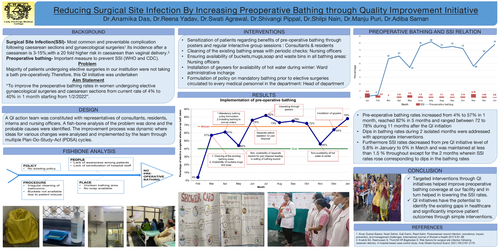
Surgical Site Infection(SSI)- Most common and preventable complication following caesarean sections and gynaecological surgeries1.Its incidence after a caesarean is 3-15%,with a 20 fold higher risk in caesarean than vaginal delivery.2 Preoperative bathing- Important measure to prevent SSI (WHO and CDC). Problem-Majority of patients undergoing elective surgeries in our institution were not taking a bath pre-operatively.Therefore, this QI initiative was undertaken with the Aim Statement “To improve the preoperative bathing rates in women undergoing elective gynaecological surgeries and caesarean sections from current rate of 4% to 40% in 1 month starting from 1/2/2022”.
DESIGN:
A QI action team was constituted with representatives of consultants, residents, interns and nursing officers. A fish-bone analysis of the problem was done and the probable causes were identified. The improvement process was dynamic where ideas for various changes were analysed and implemented by the team through multiple Plan-Do-Study-Act (PDSA) cycles.
INTERVENTIONS:
Sensitization of patients regarding benefits of pre-operative bathing through posters and regular interactive group sessions : Consultants & residents, Cleaning of the existing bathing areas with periodic checks: Nursing officers, Ensuring availability of buckets,mugs,soap and waste bins in all bathing areas: Nursing officers, Installation of geysers for availability of hot water during winter: Ward administrative incharge, Formulation of policy on mandatory bathing prior to elective surgeries circulated to every medical personnel in the department: Head of department
RESULTS:
Pre-eoperative bathing rates increased from 4% to 57% in 1 month, reached 82% in 5 months and ranged between 72 to 78% during 11 months after the QI initiation. Dips in bathing rates during 2 isolated months were addressed with appropriate interventions Furthermore SSI rates decreased from pre QI initiative level of 5.8% in January to 0% in March and was maintained at less than 1.5 % throughout except for the 2 months wherein SSI rates rose corresponding to dips in the bathing rates.
CONCLUSION:
Targeted interventions through QI initiatives helped improve preoperative bathing coverage at our facility and in turn helped in lowering the SSI rates. QI initiatives have the potential to identify the existing gaps in healthcare and significantly improve patient outcomes through simple interventions.
REFERENCES:
1. Sivan Zuarez-Easton, Noah Zafran, Gali Garmi, Raed Salim. Postcesarean wound infection: prevalence, impact, prevention, and management challenges. International Journal of Women’s Health 2017:9 81–88
2. Kvalvik SA, Rasmussen S, Thornhill HF,Baghestan E. Risk factors for surgical site infection following cesarean delivery: A hospital-based case-control study. Acta Obstet Gynecol Scand. 2021;100:2167–2175.