Loading...

1,830 posters, 67 videos, 75 audios, 29 topics, 22 sessions, 4,727 authors, 1,697 institutions

ePostersLive by SciGen Technologies S.A. All rights reserved.

RCOG World Congress 2023

June 12 - 14, 2023 | London, UK

RCOG World Congress 2023 banner

EP.0119

Global investment in contraceptive R&D: the current state of play
Part of Topic

Sexual Health and Contraception

GLOBAL INVESTMENT IN CONTRACEPTION R&D: THE STATE OF PLAY

Objectives: New contraceptive methods are needed that meet the needs of users, including methods that are user-controlled, less/non-hormonal, and can be used by men, women, or both. Investment in contraceptive R&D however is under-resourced. We analysed contraceptive R&D funding from 2018-2021, assessing scale, distribution, funders and trends.

Methods: Policy Cures Research’s G-FINDER project tracks annual investment in R&D for biomedical products that address global health challenges disproportionately affecting people in LMICs, including contraception. Contraceptive R&D investment data was collected from funders, intermediaries and product developers from 2018-2021 via the G-FINDER survey. Participants were identified leveraging G-FINDER’s comprehensive 16-year database, and landscaping for organisations active in contraceptive R&D. Data was analysed by product types, R&D stage and funder, using excel.

Results:

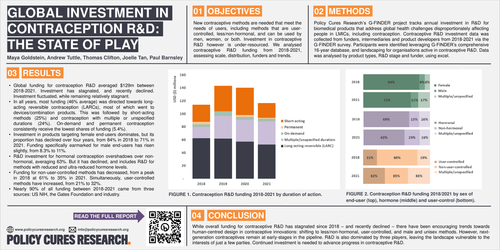
•Global funding for contraception R&D averaged $129m between 2018-2021. Investment has stagnated, and recently declined. Investment fluctuated, while remaining relatively stagnant.
 
•In all years, most funding (46% average) was directed towards long-acting reversible contraception (LARCs), most of which went to devices/combination products. This was followed by short-acting methods (25%) and contraception with multiple or unspecified durations (24%). On-demand and permanent contraception consistently receive the lowest shares of funding (5.4%). 
 
•Investment in products targeting female end-users dominates, but its proportion has declined over four years, from 84% in 2018 to 71% in 2021. Funding specifically earmarked for male end-users has risen slightly, from 8.3% to 11%. 
 
•R&D investment for hormonal contraception overshadows over non-hormonal, averaging 63%. But it has declined, and includes R&D for methods with reduced and ultra-reduced hormone levels. 
 
•Funding for non-user-controlled methods has decreased, from a peak in 2018 at 61% to 35% in 2021. Simultaneously, user-controlled methods have increased, from 21% to 32%. 
 
•Nearly 90% of all funding between 2018-2021 came from three sources: US NIH, the Gates Foundation and industry.
 
Conclusions: While overall funding for contraceptive R&D has stagnated since 2018 – and recently declined – there have been encouraging trends towards human-centred design in contraceptive innovations: shifting to less/non-hormonal, user-controlled, and male and unisex methods. However, next-generation contraceptives remain at early-stages in the pipeline. R&D is also dominated by three players, leaving the landscape vulnerable to the interests of just a few parties. Continued investment is needed to advance progress in contraceptive R&D.
RCOG World Congress 2023 » banner
Copyright © 2015-2026, ePostersLive® SciGen is a registered trademark of SciGen Technologies S.A. Patent pending.

This website and third-party tools we use rely on cookies for the best user experience. By selecting "I agree", you agree to cookie usage as described in our Privacy Policy.