1,830 posters, 67 videos, 75 audios, 29 topics, 22 sessions, 4,727 authors, 1,697 institutions
ePostersLive by SciGen Technologies S.A. All rights reserved.
RCOG World Congress 2023
June 12 - 14, 2023 | London, UK

EP.1187
Quantification of blood loss at the time of delivery- a safer practice!
Poster Presenter
Authors
Alfia Fatma, Ruqayyah Kamal, Salmah AlAbsi, Muhammad Jahangir, Manal AlKherbash, Mohammad AlSaeed
Affiliations
Part of Topic
Quality Improvement
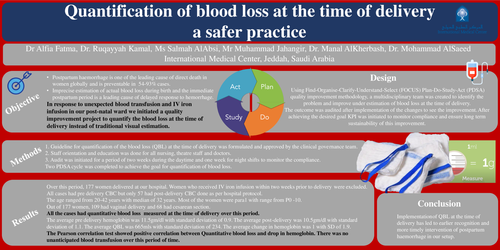
Quantification of blood loss at the time of delivery a safer practice
Objective
Postpartum haemorrhage is one of the leading cause of direct death in women globally and is preventable in 54-93% cases. • Imprecise estimation of actual blood loss during birth and the immediate postpartum period is a leading cause of delayed response to hemorrhage. In response to unexpected blood transfusion and IV iron infusion in our post-natal ward we initiated a quality improvement project to quantify the blood loss at the time of delivery instead of traditional visual estimation
Design
Using Find-Organise-Clarify-Understand-Select (FOCUS) Plan-Do-Study-Act (PDSA) quality improvement methodology, a multidisciplinary team was created to identify the problem and improve under estimation of blood loss at the time of delivery. The outcome was audited after implementation of the changes to see the improvement. After achieving the desired goal KPI was initiated to monitor compliance and ensure long term sustainability of this improvement.
Methods
1. Guideline for quantification of the blood loss (QBL) at the time of delivery was formulated and approved by the clinical governance team. 2. Staff orientation and education was done for all nursing, theatre staff and doctors. 3. Audit was initiated for a period of two weeks during the daytime and one week for night shifts to monitor the compliance. Two PDSA cycle was completed to achieve the goal for quantification of blood loss.
Results
Over this period, 177 women delivered at our hospital. Women who received IV iron infusion within two weeks prior to delivery were excluded. All cases had pre delivery CBC but only 57 had post-delivery CBC done as per hospital protocol. The age ranged from 20-42 years with median of 32 years. Most of the women were para1 with range from P0 -10. Out of 177 women, 109 had vaginal delivery and 68 had cesarean section. All the cases had quantitative blood loss measured at the time of delivery over this period. The average pre delivery hemoglobin was 11.5gm/dl with standard deviation of 0.9. The average post-delivery was 10.5gm/dl with standard deviation of 1.1. The average QBL was 665mls with standard deviation of 234. The average change in hemoglobin was 1 with SD of 1.9. The Pearson correlation test showed positive correlation between Quantitative blood loss and drop in hemoglobin. There was no unanticipated blood transfusion over this period of time.
Conclusion
Implementationof QBL at the time of delivery has led to earlier recognition and more timely intervention of postpartum haemorrhage in our setup.