1,830 posters, 67 videos, 75 audios, 29 topics, 22 sessions, 4,727 authors, 1,697 institutions
ePostersLive by SciGen Technologies S.A. All rights reserved.
RCOG World Congress 2023
June 12 - 14, 2023 | London, UK

EP.1186
Analysis of patient complaints in maternity at UHL using coding taxonomy
Poster Presenter
Authors
Saadia Munawar, Farah Shakeel, Evita Nausedaite, Chandrima Roy, Humera Ansar
Affiliations
Part of Topic
Quality Improvement
BACKGROUND:
The NHS Complaint Standards defines a complaint as an expression of dissatisfaction that requires a response.
It can be about an act, omission or decision you have made, and/or the standard of service you have provided. [1]. According to national statistics presented by NHS Digital there were 170,013 patient complaints received in 2020-21, 465 complaints per day. This is no different to the number of complaints received in 2013-14, when it was reported to beover 175000 written complaints, equivalent to 479.1 complaints per day.
Patient complaints provide a large and distinctive pool of data that gives patient-centered insights into areas not identified by adverse incident reporting systems and can be a valuable source to identify specific problems in the healthcare setting. Such insights may often be applicable beyond the department in which the incident took place and provide a point for wider system learning.
The patient perspective is important because users of health services may have a different view of problems to those reported by health professionals in the adverse incident reporting systems that are now routine practice in many countries [2, 3]. Complaints from patients often relate to safety and service quality problems in their care [4,5], as well as concerns about treatment and poor communication with health professionals [3]. Often, they can be a marker of dysfunctional teams.
Complaints have a significant impact on the staff morale and confidence. They need to write reflections and have to disclose in ARCP’s and appraisals. It also affects the organization by increasing the demand on staff time and allocation and has significant financial implications as well. It affects the patients as they lose trust in the care provided.
Inadequate complaint management by service providers has led to high profile investigations as seen in the recent reviews in the NHS Maternity care settings [6,7,8]. In such cases, the failure to listen to patient concerns and then to implement reforms led to major quality and safety failures.
AIMS AND OBJECTIVES:
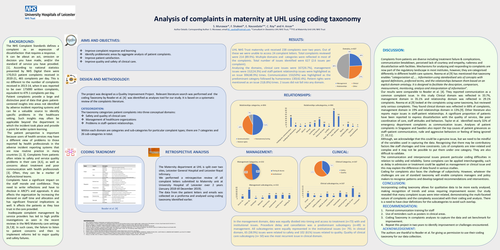
The project was designed as a Quality Improvement Project. Relevant literature search was performed and the coding Taxonomy by Reader et al. [4] was identified as analyses tool for our study. It is based on a systematic review of the complaints literature.
CATEGORIZATION:
The taxonomy categorizes patient complaints into three conceptual domains:
Within each domain are categories and sub-categories for particular complaint types; there are 7 categories and
26 sub-categories in total.
RETROSPECTIVE ANALYSIS:
The Maternity department at UHL is split over two sites, Leicester General Hospital and Leicester Royal Infirmary.
We performed a retrospective review of all complaint letters submitted to Maternity unit at University Hospital of Leicester over 2 years (January 2018 till December 2019).
The data from the patient letters and emails was collected on a proforma and analysed using coding taxonomy identified earlier.
RESULTS:
UHL NHS Trust maternity unit received 238 complaints over two years. Out of these we were unable to access 24 complaint letters. Total complaints reviewed were 214 (89.9%). Multiple domains and categories were reflected in most of the complaints. Total number of issues identified were 627 (2.6 issues per complaint).
Analysing the domains, clinical care issues were 167(26.7%), management issues were 152(24.3%) and staff-patient relationship issues were highlighted as an issue 306(48.9%) times. Communication 155(50%) was highlighted as the predominant category followed by humaneness 130(42.4%). Patient rights were mentioned as an issue 21(6.8%) times. 2 issues did not fall into any domain.
In the management domain, data was equally divided into timing and access to treatment (n=73) with and institutional issues. Procedure delay and cancellation was a predominant subcategory (n=49) in management. All subcategories were equally represented in the institutional issues (n= 79). In clinical domain, 65 (38.9%) issues were related to safety and 102 (61%) issues related to quality. Quality of clinical care subcategory (n= 50) was the most recurrent issue in clinical domain.
DISCUSSION:
Complaints from patients are diverse including treatment failure & complications, communication breakdown, perceived lack of courtesy and empathy, rudeness and dissatisfaction with facilities. Mechanisms for analysing and responding to complaints are now part of the regulatory landscape in most institutes, however, they are categorised differently in different health care systems. Reema et al [9] has mentioned that taxonomy enables “categorisation of…… Information using standardised sets of concepts with agreed definitions, preferred terms, and the relationships between them based on an explicit domain ontology. It is designed to facilitate the description, comparison, measurement, monitoring, analysis and interpretation of information”.
Our results were comparable to Reader et al. [4]. They reported communication as a common complaint issue. In this study Clinical domain was reflected in 33.7%, management domain in 35.1% and relationship domain was reflected in 29.1% complaints. Reema et al.[9] looked at the complaints using same taxonomy, but reviewed only serious complaints. They found clinical domain was reflected in 68% of complaints, management domain in 19% and relationships domain in 13%.[9]. Other literature also reports major issues in staff-patient relationships. A significant proportion of patients have been reported to express dissatisfaction with the quality of service, like poor coordination of care, staff attitudes and behaviors. Taylor et al. identified nearly 32% of emergency department complaints as communication issues. Analyses of patient complaints in Singapore and Sweden also report the top causes of patient grievances as staff–patient communication, rude and aggressive behaviors or feeling of being ignored [7, 10,11].
Although, we acknowledge that this could be a genuine issue, but we need to be mindful of the variables used in capturing the data. Recognising that there may be contributory factors like staff shortages and time constraints. Lots of complaints are inter-related and complex and it may not be possible to put them under one category. They are also difficult to validate.
The communication and interpersonal issues present particular coding difficulties in relation to validity and reliability. Some complains can be applied interchangeably, such as delay in admission or treatment could be applied as management or clinical issue and this may explain the difference of data found in various studies.
Coding for complaints also faces the challenge of subjectivity. However, whatever the challenges are use of standard taxonomy will enable complains managers and policy makers to recognise patterns and develop targeted recommendations and interventions.
CONCLUSION:
Incorporating coding taxonomy allows for qualitative data to be more easily analysed, making recognition of trends and areas requiring improvement easier. Our study revealed that many complaint issues were inter-related, demonstrating the multi-faceted nature of complaints and the complexity associated with their coding and analysis. There is a need to have clear definitions for the subcategories to avoid such overlap.
RECOMMENDATION:
ACKNOWLEDGEMENT:
The authors are thankful to Reader et al. for giving us permission to use their coding taxonomy for our data collection.
REFERENCES: