1,830 posters, 67 videos, 75 audios, 29 topics, 22 sessions, 4,727 authors, 1,697 institutions
ePostersLive by SciGen Technologies S.A. All rights reserved.
RCOG World Congress 2023
June 12 - 14, 2023 | London, UK

EP.1168
An Audit on endometrial biopsy: a Sri Lanka tertiary care center experience
Poster Presenter
Part of Topic
Quality Improvement
An Audit on endometrial biopsy assessment and follow-up: a Sri Lanka tertiary care centre experience
Raguraman S, Guruparan K
Department of Obstetrics and Gynaecology, University of Jaffna
Objective: To evaluate the endometrial assessment and follow-up care in our unit and identify the aspects, that need improvement.
Design: An institutional-based retrospective audit was carried out in the teaching hospital, Jaffna from January 2022 to June 2022 among the participants who attended with a history of abnormal uterine bleeding to the gynaecological clinic.
Method: all of the 103 patients who came to the gynaecological clinic and waited for endometrial biopsy due to a history of abnormal uterine bleeding for more than one year and not responding to the initial medical management were recruited during the study period. Traditional dilatation and curettage (D&C) and Hysteroscopy guided biopsy methods were used to collect the endometrial biopsy and all samples were sent for histological analysis.
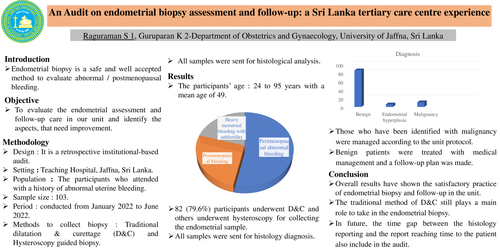
Results: The data revealed that the participants' age ranges from 24 to 95 years with a mean age of 49. Around 55(53.4%) participants were having perimenopausal abnormal bleeding, 27 (26.2%) participants were having post-menopausal bleeding and the rest of the 21 participants were having heavy menstrual bleeding with Sub-fertility. Among them 82 (79.6%) participants underwent D&C and others underwent hysteroscopy for collecting the endometrial sample. All samples were sent for histology diagnosis and around 86 (83.5%) participants were diagnosed with benign, 6 participants were diagnosed with endometrial hyperplasia and 11 participants were diagnosed with malignancy. Those who have been identified with malignancy were managed according to the unit protocol and benign patients were treated with medical management and a follow-up plan was made.
Conclusion: This audit revealed the importance of endometrial assessment and follow-up. Overall results have shown the satisfactory practice of endometrial biopsy and follow-up in the unit. The traditional method of D&C still plays a main role to take in the endometrial biopsy. In future, the time gap between the histology reporting and the report reaching time to the patient also include in the audit.