1,830 posters, 67 videos, 75 audios, 29 topics, 22 sessions, 4,727 authors, 1,697 institutions
ePostersLive by SciGen Technologies S.A. All rights reserved.
RCOG World Congress 2023
June 12 - 14, 2023 | London, UK

EP.0103
Piloting a new risk based triage tool for Gynaecological emergencies.
Poster Presenter
Authors
Affiliations
Part of Topic
Quality Improvement
Piloting a New Risk-Based Triage Tool for Gynaecological Emergencies
Dr Mohamed Saleh – Miss Rakhee Saxena Nottingham University Hospitals NHS Trust
Introduction:
The Gynaecology Triage Unit (GTU) at our hospital is the second busiest Same Day Emergency Care (SDEC) area in our trust. It handles an extensive patient load, reviewing 40 to 60 patients daily, and approximately 1300 patients monthly. Despite the high volume of patients, the unit currently lacks a standardised system for triaging women presenting with gynaecological complications or concerns. As a result, patients are predominantly seen based on their arrival time, rather than the severity or nature of their presenting symptoms.
Objectives and Methodology:
The primary objective of this project was to introduce and pilot a new risk- based triage tool specifically designed for women attending with gynaecological emergencies and early pregnancy complications. Our aim was to transform the triage process to a system that prioritises patients based on their clinical urgency. This approach was intended to improve the efficiency and quality of patient care, reducing wait times, and enhancing patient and healthcare provider satisfaction.
Methods:
We piloted the new triage tool for two weeks at Queens Medical Centre, managing a total of 184 cases. Data on average time spent in the unit and feedback from patients, doctors, and nurses was collected and compared to similar data during a period of normal operations.
Triage system overview:
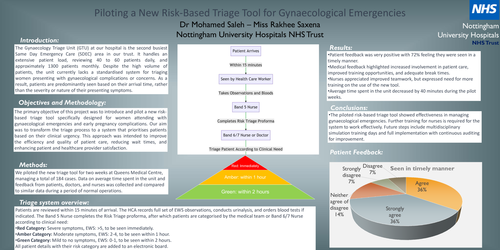
Patients are reviewed within 15 minutes of arrival. The HCA records full set of EWS observations, conducts urinalysis, and orders blood tests if indicated. The Band 5 Nurse completes the Risk Triage proforma, after which patients are categorised by the medical team or Band 6/7 Nurse according to clinical need:
•Red Category: Severe symptoms, EWS: >5, to be seen immediately.
•Amber Category: Moderate symptoms, EWS: 2-4, to be seen within 1 hour. •Green Category: Mild to no symptoms, EWS: 0-1, to be seen within 2 hours. All patient details with their risk category are added to an electronic board.
Results:
•Patient feedback was very positive with 72% feeling they were seen in a timely manner.
•Medical feedback highlighted increased involvement in patient care, improved training opportunities, and adequate break times.
•Nurses appreciated improved teamwork, but expressed need for more training on the use of the new tool.
•Average time spent in the unit decreased by 40 minutes during the pilot weeks.
Conclusions:
The piloted risk-based triage tool showed effectiveness in managing gynaecological emergencies. Further training for nurses is required for the system to work effectively. Future steps include multidisciplinary simulation training days and full implementation with continuous auditing for improvement.