Loading...

1,830 posters, 67 videos, 75 audios, 29 topics, 22 sessions, 4,727 authors, 1,697 institutions

ePostersLive by SciGen Technologies S.A. All rights reserved.

RCOG World Congress 2023

June 12 - 14, 2023 | London, UK

RCOG World Congress 2023 banner

EP.1040

Service evaluation of virtual gynaecology clinics introduced following the covid 19 pandemic.
Part of Topic

Telemedicine

A service evaluation of virtual gynaecology outpatient clinics introduced in Aneurin Bevan University Health Board as a result of the covid 19 pandemic.

Cara Leighton, Medical Student Cardiff University and Nida Afshan, Consultant Gynaecologist Aneurin Bevan UHB

Background

•The COVID-19 pandemic had a massive impact on the delivery of healthcare worldwide due to infection control measures stopping patients from having face-to-face appointments.
•In England in 2020-21 the pandemic caused an 18.4%  decrease in the number of hospital outpatient appointments compared to the previous year. (1)
•In Aneurin Bevan University Health Board during this period, gynaecology clinics were originally cancelled and when re-started ran at almost half the capacity they had prior to the pandemic, resulting in long waiting lists.
•To combat this, virtual evaluation clinics were introduced, in which senior registrars (grades ST5 and above) reviewed whether patients could be discharged.

Aim - To assess how successful the clinics were through looking at how many patients were seen, what proportion were discharged and, when follow up was needed, whether it was face to face or telephone.

Methods

Data was collected retrospectively by one researcher (CL) from clinic notes on Clinical Work Station using a proforma and simple statistical analysis was carried out, assisted by Microsoft Excel. (2)

This study was carried out as part of an undergraduate student selected component between 14th March to 22nd April 2022, collecting data from clinics running between 20 September 2021 and 20th March 2022.

Results

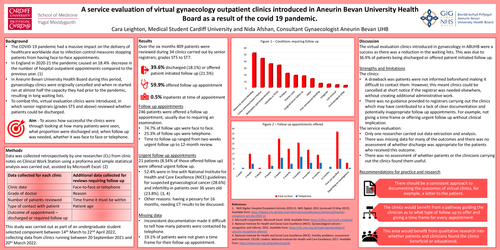
Over the six months 409 patients were reviewed during 34 clinics carried out by senior registrars; grades ST5 to ST7.

39.6% discharged (18.1%) or offered patient initiated follow up (21.5%)

59.9% offered follow up appointment

0.5% inpatients at time of appointment

Follow up appointments

246 patients were offered a follow up appointment, usually due to requiring an examination.

•74.7% of follow ups were face to face.
•25.3% of follow ups were telephone.
•Time to follow up ranged from two weeks urgent follow up to 12-month review.

Urgent follow up appointments

21 patients (8.54% of those offered follow up) were offered urgent follow up.

•52.4% were in line with National Institute for Health and Care Excellence (NICE) guidelines for suspected gynaecological cancer (28.6%) and infertility in patients over 36 years old (23.8%). (3, 4)
•Other reasons: having a pessary for 16 months, needing CT results to be discussed.

Missing data

•Inconsistent documentation made it difficult to tell how many patients were contacted by telephone.
•19.1% of patients were not given a time frame for their follow up appointment.

Discussion

The virtual evaluation clinics introduced in gynaecology in ABUHB were a success as there was a reduction in the waiting lists. This was due to 36.9% of patients being discharged or offered patient initiated follow up. 

Strengths and limitations

The clinics:

•A drawback was patients were not informed beforehand making it difficult to contact them. However, this meant clinics could be cancelled at short notice if the registrar was needed elsewhere, without creating additional administrative work.
•There was no guidance provided to registrars carrying out the clinics which may have contributed to a lack of clear documentation and potentially inappropriate follow up appointments. For example, not giving a time frame or offering urgent follow up without clinical implication.

The service evaluation:

•Only one researcher carried out data extraction and analysis.
•There was missing data for many of the outcomes and there was no assessment of whether discharge was appropriate for the patients who received this outcome.
•There was no assessment of whether patients or the clinicians carrying out the clinics found them useful.

Recommendations for practice and research


•There should be a consistent approach to documenting the outcomes of virtual clinics, for example, a letter to the patient.
•The clinics would benefit from a pathway guiding the clinician as to what type of follow up to offer and giving a time frame for every appointment.
•This area would benefit from qualitative research into whether patients and clinicians found the clinics beneficial or educational.


References:


1.  NHS Digital. Hospital Outpatient Activity 2020-21. NHS Digital; 2021 [accessed 23 May 2023]. Available from: https://digital.nhs.uk/data-and-information/publications/statistical/hospital-outpatient-activity/2020-21


2. Microsoft Corporation. Microsoft Excel. 2018. Available from: https://office.microsoft.com/excel


3. National Institute for Health and Social Care Excellence [NICE]. Gynaecological cancers – recognition and referral. 2021. Available from: https://cks.nice.org.uk/topics/gynaecological-cancers-recognition-referral/


4. National Institute for Health and Social Care Excellence [NICE]. Fertility problems: assessment and treatment. CG156. London: National Institute for Health and Care Excellence; 2017. Available from: https://www.nice.org.uk/guidance/cg156


RCOG World Congress 2023 » banner
Copyright © 2015-2026, ePostersLive® SciGen is a registered trademark of SciGen Technologies S.A. Patent pending.

This website and third-party tools we use rely on cookies for the best user experience. By selecting "I agree", you agree to cookie usage as described in our Privacy Policy.