1,830 posters, 67 videos, 75 audios, 29 topics, 22 sessions, 4,727 authors, 1,697 institutions
ePostersLive by SciGen Technologies S.A. All rights reserved.
RCOG World Congress 2023
June 12 - 14, 2023 | London, UK

EP.1028
A curious case of familiar predisposition to pelvic inflammatory disease
Poster Presenter
Authors
Affiliations
Part of Topic
Sexual Health and Contraception
A curious case of familiar predisposition to pelvic inflammatory disease
Objective
This is a case of multigenerational recurrent PID that highlights the importance of genetic factors in developing the disease and the impact of family history on treatment.
Case report:
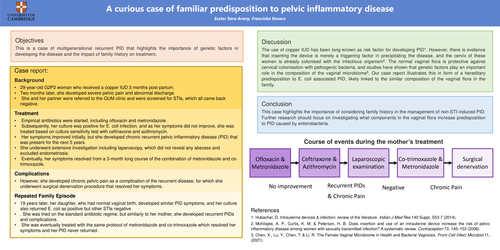
This is a case report of a 29-year-old G2P2 woman who received a copper IUD 3 months post-partum. Two months later, she developed severe pelvic pain and abnormal discharge. She and her partner were referred to the GUM clinic and were screened for STIs, which all came back negative. Empirical antibiotics were started, including ofloxacin and metronidazole. Subsequently, her culture was positive for E. coli infection, and as her symptoms did not improve, she was treated based on culture sensitivity test with ceftriaxone and azithromycin. Her symptoms improved initially, but she developed chronic recurrent pelvic inflammatory disease (PID) that was present for the next 5 years. She underwent extensive investigation including laparoscopy, which did not reveal any abscess and excluded endometriosis. Eventually, her symptoms resolved from a 3-month long course of the combination of metronidazole and co-trimoxazole. However, she developed chronic pelvic pain as a complication of the recurrent disease, for which she underwent surgical denervation procedure that resolved her symptoms. 19 years later, her daughter, who had normal vaginal birth, developed similar PID symptoms, and her culture also returned E. coli as positive but other STIs negative. She was tried on the standard antibiotic regime, but similarly to her mother, she developed recurrent PIDs and complications. She was eventually treated with the same protocol of metronidazole and co-trimoxazole which resolved her symptoms and her PID never returned.
Discussion:
The use of copper IUD has been long-known as risk factor for developing PID1. However, there is evidence that inserting the device is merely a triggering factor in precipitating the disease, and the cervix of these women is already colonised with the infectious organism2. The normal vaginal flora is protective against cervical colonisation with pathogenic bacteria, and studies have shown that genetic factors play an important role in the composition of the vaginal microbiome3. Our case report illustrates this in form of a hereditary predisposition to E. coli associated PID, likely linked to the similar composition of the vaginal flora in the family.
Conclusions:
This case highlights the importance of considering family history in the management of non-STI-induced PID. Further research should focus on investigating what components in the vaginal flora increase predisposition to PID caused by enterobacteria.
1. Hubacher, D. Intrauterine devices & infection: review of the literature. Indian J Med Res 140 Suppl, S53-7 (2014).
2. Mohllajee, A. P., Curtis, K. M. & Peterson, H. B. Does insertion and use of an intrauterine device increase the risk of pelvic inflammatory disease among women with sexually transmitted infection? A systematic review. Contraception 73, 145–153 (2006).
3. Chen, X., Lu, Y., Chen, T. & Li, R. The Female Vaginal Microbiome in Health and Bacterial Vaginosis. Front Cell Infect Microbiol 11, (2021).