296 posters, 7 videos, 13 audios, 14 topics, 10 sessions, 1,019 authors, 259 institutions
ePostersLive by SciGen Technologies S.A. All rights reserved.
RCOphth Annual Congress 2026
18 - 21 May, 2026 | Manchester Central, Manchester

P194
Service Evaluation of the Prevalence of Hydroxychloroquine Retinopathy using the 2020 Royal College of Ophthalmologists Revised Diagnostic Criteria
Poster Presenter
Authors
Part of Topic
Medical retina
Audio
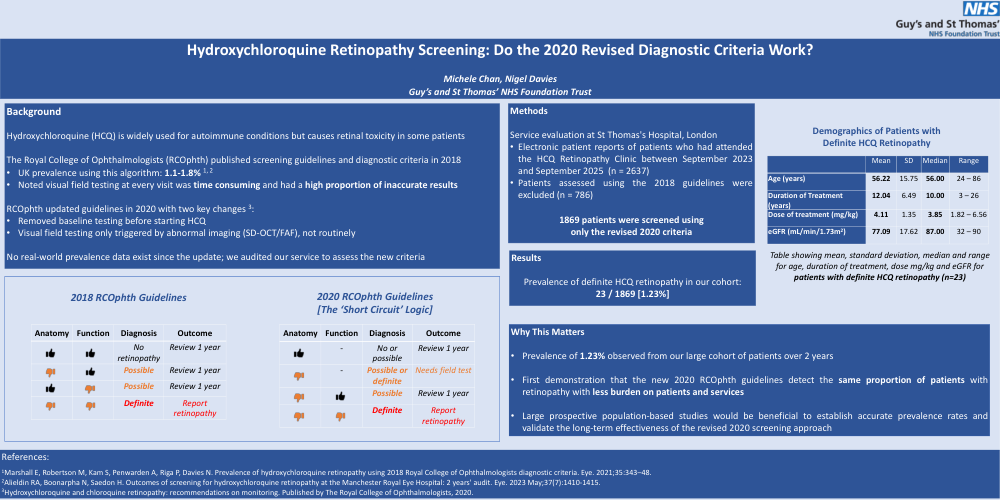
Hydroxychloroquine (HCQ) is a quinine derivative licensed in the United Kingdom for long-term treatment of many autoimmune conditions. Its association with development of retinal toxicity has been well-characterised. The Royal College of Ophthalmologists (RCOphth) published guidelines in 2018 recommending screening of patients taking HCQ to assess for anatomical and functional abnormalities using spectral-domain optical coherence tomography (SD-OCT), fluorescein autofluorescence (FAF) and Humphrey 10-2 visual field testing respectively. Using this methodology the prevalence of definite retinopathy is in the range 1.1 – 1.8%. Studies noted however that visual field testing at every visit was time consuming and generated a high proportion of inaccurate results. The guidelines were updated in 2020 following evidence from real-world audit data and feedback from UK retinal specialists. Definitions of definite and possible retinopathy remain unchanged, with key modification to the algorithm being the removal of baseline testing prior to starting HCQ and the use of ‘short circuit’ logic to ensure the same outcome set. This entails visual field testing in patients only in the presence of anatomical abnormality to establish whether both function and anatomy are affected. There have not been any published studies on the real-world prevalence since changes from the original 2018 guidelines, warranting an updated evaluation using the revised 2020 monitoring algorithm.
A service evaluation of the HCQ retinopathy monitoring programme at St Thomas’s Hospital, London. 1869 patients who attended between September 2023 and September 2025 monitored according to the 2020 guidelines were included. Patients assessed using the 2018 guidelines were excluded. Patient demographics, patient-reported treatment duration, dosing (mg/kg), and estimated glomerular filtration rate (eGFR) were recorded for all cases of retinopathy.
Definite HCQ retinopathy was identified in 23 patients (19 male, 4 female) according to the new 2020 RCOphth diagnostic criteria, giving a prevalence of 1.23%. The mean age of patients at diagnosis was 56.2 (SD 15.8) with an average of 12.0 years of treatment (SD 6.5 years). Five patients had an eGFR of less than 60 mL/min/1.73m2, and one patient was taking concomitant tamoxifen therapy.
Our prevalence of 1.23% for definite HCQ retinopathy is comparable to audits of a similar scale and patient demographic of 1.1-1.8% in the United Kingdom. The 2020 guidelines were designed to be more cost and time effective than previous iterations, and our findings support this objective. The prevalence of 1.23% observed from our large cohort of patients over 2 years suggests that the revised algorithm successfully identified patients with retinopathy, while potentially relieving demand on clinical services. Large prospective population-based studies would be beneficial to establish accurate prevalence rates and validate the long-term effectiveness of the revised 2020 screening approach.