296 posters, 7 videos, 13 audios, 14 topics, 10 sessions, 1,019 authors, 259 institutions
ePostersLive by SciGen Technologies S.A. All rights reserved.
RCOphth Annual Congress 2026
18 - 21 May, 2026 | Manchester Central, Manchester

P189
Robust Vision Gain and Anatomic Improvement with Faricimab in Patients with Polypoidal Choroidal Vasculopathy: Week 48 Results From SALWEEN
Poster Presenter
Authors
Ian Pearce, Timothy Lai, Gemmy Cheung, Shih-Jen Chen, Tomohiro Iida, Adrian Hock Chuan Koh, Junyeop Lee, Won Ki Lee, Xiaorong Li, Paisan Ruamviboonsuk, Xiaodong Sun, Yasuo Yanagi, Ruobing Bai, Anh Nguyen Duc, Philippe Margaron
Affiliations
Roche Products Ltd., Welwyn Garden City, UK, Liverpool University Hospitals NHS Foundation Trust, Liverpool, UK, Department of Ophthalmology and Visual Sciences, The Chinese University of Hong Kong, Hong Kong, New Territories, China, Singapore Eye Research Institute, Singapore National Eye Centre, Duke-NUS Medical School, National University of Singapore, Republic of Singapore, Taipei Veterans General Hospital, National Yang Ming Chiao Tung University, Taipei, Taiwan, Tokyo Women’s Medical University, Tokyo, Japan, Eye & Retina Surgeons, Camden Medical Centre, Republic of Singapore, Department of Ophthalmology, Asan Medical Center, University of Ulsan College of Medicine, Seoul, South Korea, Nune Eye Hospital, Seoul, South Korea, Tianjin Medical University Eye Hospital, Tianjin, China, College of Medicine, Rajavithi Hospital, Rangsit University, Bangkok, Thailand, Department of Ophthalmology, Shanghai General Hospital, Shanghai Eye Research Institute, Shanghai, China, Department of Ophthalmology and Microtechnology, Yokohama City University, Yokohama, Japan, F. Hoffmann-La Roche Ltd., Basel, Switzerland
Part of Topic
Medical retina
Introduction
PCV is a subtype of nAMD that is frequently underdiagnosed and reflects a more difficult-to-treat subtype1
►
Week 16 results from the SALWEEN trial in patients with PCV from Asia demonstrated that patients treated with faricimab, a dual Ang-2/VEGF-A inhibitor, experienced robust vision and anatomic improvements2
Methods
►
SALWEEN (ISRCTN69073386) is a phase 3b/4 multicentre, open-label, single-arm study that evaluated the efficacy, safety and durability of faricimab in PCV in Asia
►
Patients with symptomatic macular PCV (N = 135) received 4 initial Q4W doses of faricimab6 mg, followed by faricimabQ8W, Q12W or Q16W based on disease activity assessments at weeks 20/24
►
From week 44/48 to week 104, faricimab dosing followed a T&E-based regimen, with treatment intervals ranging from Q8W to Q20W
►
The primary endpoint was change from baseline in BCVA averaged over weeks 40, 44 and 48
►
Other endpoints included change from baseline in CST, central choroidal thickness, proportion of patients with absence of IRF and SRF, resolution of polypoidal lesions, durability and safety
Results
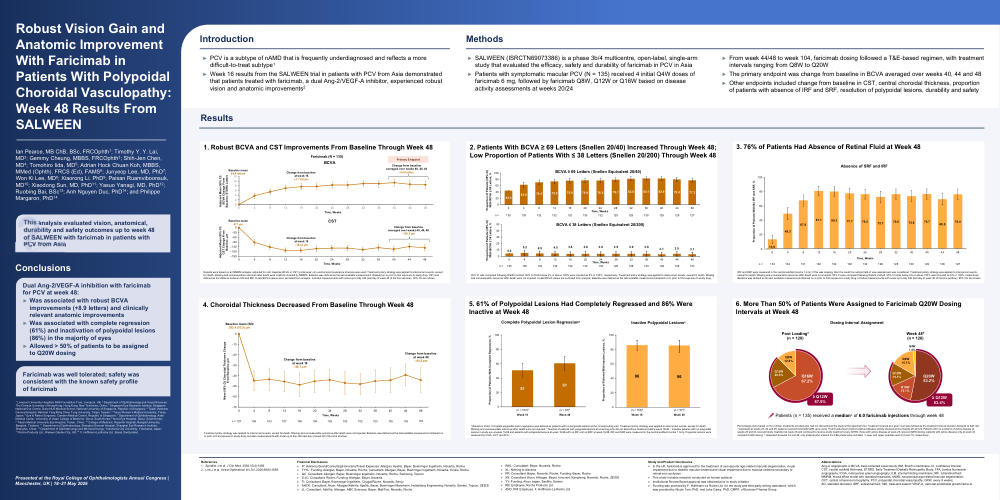
1. Robust BCVA and CST Improvements From Baseline Through Week 48
2. Patients With BCVA ≥ 69 Letters (Snellen 20/40) Increased Through Week 48; Low Proportion of Patients With ≤ 38 Letters (Snellen 20/200) Through Week 48
3. 76% of Patients Had Absence of Retinal Fluid at Week 48
4. Choroidal Thickness Decreased From Baseline Through Week 48
5. 61% of Polypoidal Lesions Had Completely Regressed and 86% Were Inactive at Week 48
6. More Than 50% of Patients Were Assigned to FaricimabQ20W Dosing Intervals at Week 48
This analysis evaluated vision, anatomical, durability and safety outcomes up to week 48 of SALWEEN with faricimab in patients with PCV from Asia
Conclusions
Dual Ang-2/VEGF-A inhibition with faricimab for PCV at week 48:
►
Was associated with robust BCVA improvements (+8.9 letters) and clinically relevant anatomic improvements
►
Was associated with complete regression (61%) and inactivation of polypoidal lesions (86%) in the majority of eyes
►
Allowed > 50% of patients to be assigned to Q20W dosing
Faricimab was well tolerated; safety was consistent with the known safety profile of faricimab