296 posters, 7 videos, 13 audios, 14 topics, 10 sessions, 1,019 authors, 259 institutions
ePostersLive by SciGen Technologies S.A. All rights reserved.
RCOphth Annual Congress 2026
18 - 21 May, 2026 | Manchester Central, Manchester

P183
Real-World Outcomes of Switching to Faricimab in Treatment-Experienced and Resistant Neovascular Age-Related Macular Degeneration: Single-Centre Retrospective Study
Poster Presenter
Authors
Christopher Stewart, Jaskaran Singh Bhangu, Parinita Swarnkar, Mohammed Rifat, Sarah Khalid, Ahmed Al-Janabi, Mahmoud Awad, Gwyn Williams
Affiliations
Faculty of Medicine, Health, and Life Science, Swansea University, Swansea, Wales, UK, Ophthalmology department, Singleton Hospital, Swansea Bay University Health Board, Swansea, Wales, UK
Part of Topic
Medical retina
This study investigates short-term outcomes of switching to Faricimabin a UK single centre, treatment-experienced nAMD population. The primary objective was to evaluate anatomical efficacy (CMT reduction and complete macular dryness) following Faricimab switching in treatment-experienced nAMD patients over eight injections. Secondary objectives included: (1) assessing functional outcomes (BCVA change and correlation with anatomical response), (2) determining treatment interval extension capacity, (3) identifying baseline predictors of anatomical response, (4) characterising the safety profile, including intraocular inflammation incidence.
Single-centre retrospective study of 67 eyes switched to Faricimab(November 2022 to December 2024). This cohort was unable to be extended beyond 4 –6-week intervals on existing anti-VEGF therapy. Inadequate response was defined as an inability to extend intervals beyond 4–6 weeks due to the persistent presence of fluid with or without a significant drop in vision (greater than 5 letters on LogMAR). All patients received three monthly loading doses followed by a treat-and-extend regimen. Intervals were extended or reduced based on retinal activity: intervals increased by four weeks if the retina was inactive, or decreased by two weeks if the retina was active. Primary outcomes: central macular thickness (CMT), best-corrected visual acuity (BCVA), macular dryness over eight injections, and treatment interval extension. All statistical analyses were performed using R version 4.3.x and Microsoft Excel.
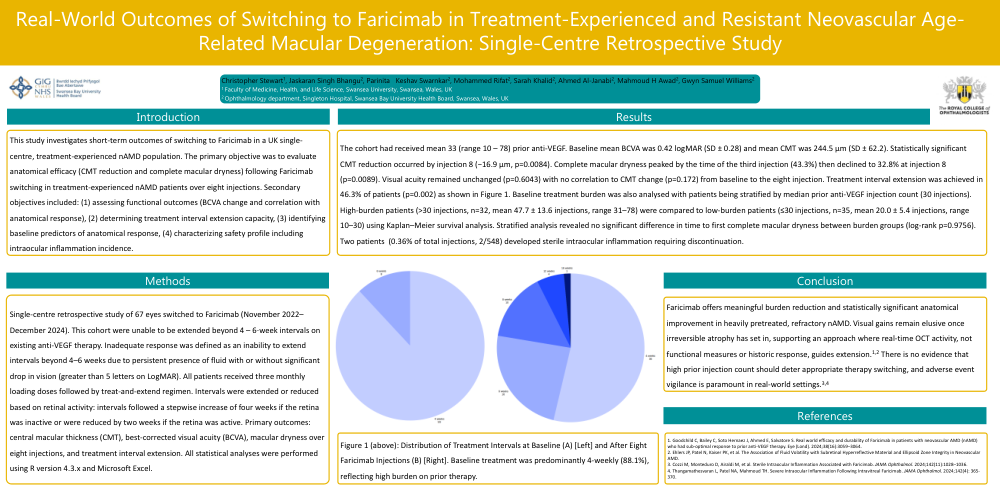
The cohort had received a mean 33 (range 10 –78) prior anti-VEGF. Baseline mean BCVA was 0.42 logMAR(SD ±0.28) and mean CMT was 244.5 μm(SD ±62.2). Statistically significant CMT reduction occurred by injection 8 (−16.9 μm, p=0.0084). Complete macular dryness peaked by the time of the third injection (43.3%), then declined to 32.8% at injection 8 (p=0.0089). Visual acuity remained unchanged (p=0.6043) with no correlation to CMT change (p=0.172) from baseline to the eighth injection. Treatment interval extension was achieved in 46.3% of patients (p=0.002) as shown in Figure 1. Baseline treatment burden was also analysed with patients being stratified by median prior anti-VEGF injection count (30 injections). High-burden patients (>30 injections, n=32, mean 47.7 ±13.6 injections, range 31–78) were compared to low-burden patients (≤30 injections, n=35, mean 20.0 ±5.4 injections, range 10–30) using Kaplan–Meier survival analysis. Stratified analysis revealed no significant difference in time first to complete macular dryness between burden groups (log-rank p=0.9756). Two patients (0.36% of total injections, 2/548) developed sterile intraocular inflammation requiring discontinuation.
Faricimab offers meaningful burden reduction and statistically significant anatomical improvement in heavily pretreated, refractory nAMD.Visual gains remain elusive once irreversible atrophy has set in, supporting an approach where real-time OCT activity, not functional measures or historic response, guides extension. 1,2 There is no evidence that high prior injection count should deter appropriate therapy switching, and adverse event vigilance is paramount in real-world settings.3,4