296 posters, 7 videos, 13 audios, 14 topics, 10 sessions, 1,019 authors, 259 institutions
ePostersLive by SciGen Technologies S.A. All rights reserved.
RCOphth Annual Congress 2026
18 - 21 May, 2026 | Manchester Central, Manchester

P182
Real-World Outcomes of Intravitreal Dexamethasone Implant (Ozurdex�) as First-Line Therapy for Diabetic Macular Oedema
Poster Presenter
Authors
Part of Topic
Medical retina
Purpose
Intravitreal steroid implants such as dexamethasone (Ozurdex®) offer a longer-acting alternative to anti-VEGF therapy in DMO. They are currently onlyrecommended as second-line therapy in pseudophakic eyes. This study aimed to evaluate functional and anatomical outcomes of Ozurdex as first-line treatment in DMO and compare these outcomes with aflibercept to assess non-inferiority in real-world practice.
Methods
A retrospective, single-centre cohort study of treatment-naïve eyes with centre-involving DMO treated with either Ozurdex or aflibercept. Inclusion criteria required no prior intravitreal therapy within 24 months and no additional treatment within 12 months following initiation, except a repeat injection.
Best-corrected visual acuity and central macular thickness (CMT) were recorded at baseline and up to 12 months. The primary outcome was change in BCVA at 12 months. A non-inferiority margin of +0.10 logMAR was predefined. Secondary outcomes included change in CMT, number of injections, intraocular pressure (IOP) rise, and cataract surgery.
Results
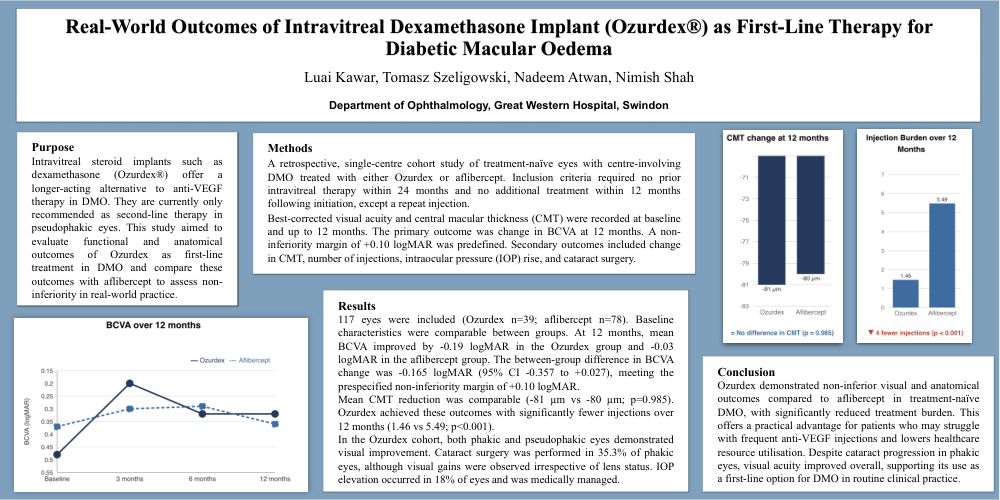
117 eyes were included (Ozurdex n=39; aflibercept n=78). Baseline characteristics were comparable between groups. At 12 months, mean BCVA improved by -0.19 logMAR in the Ozurdex group and -0.03 logMAR in the aflibercept group. The between-group difference in BCVA change was -0.165 logMAR(95% CI -0.357 to +0.027), meeting the prespecified non-inferiority margin of +0.10 logMAR.
Mean CMT reduction was comparable (-81 µm vs -80 µm; p=0.985). Ozurdex achieved these outcomes with significantly fewer injections over 12 months (1.46 vs 5.49; p<0.001).
In the Ozurdex cohort, both phakic and pseudophakic eyes demonstrated visual improvement. Cataract surgery was performed in 35.3% of phakic eyes, although visual gains were observed irrespective of lens status. IOP elevation occurred in 18% of eyes and was medically managed.
Conclusion
Ozurdex demonstrated non-inferior visual and anatomical outcomes compared to aflibercept in treatment-naïve DMO, with significantly reduced treatment burden. This offers a practical advantage for patients who may struggle with frequent anti-VEGF injections and lowers healthcare resource utilisation. Despite cataract progression in phakic eyes, visual acuity improved overall, supporting its use as a first-line option for DMO in routine clinical practice.