296 posters, 7 videos, 13 audios, 14 topics, 10 sessions, 1,019 authors, 259 institutions
ePostersLive by SciGen Technologies S.A. All rights reserved.
RCOphth Annual Congress 2026
18 - 21 May, 2026 | Manchester Central, Manchester

P174
Miscarriage Rates and Diabetic Retinopathy Outcomes in Pregnant Women with Pre-existing Diabetes in Birmingham & Solihull
Poster Presenter
Authors
Part of Topic
Medical retina
Miscarriage Rates and Diabetic Retinopathy Outcomes in Pregnant Women with Pre-existing Diabetes in Birmingham & Solihull
Miss. Xiaoli Chen1, Ms. Sobha Joseph2, Birmingham Midland Eye Centre, Sandwell and West Birmingham NHS Trust1, University Hospital Birmingham NHS Trust2
Background:
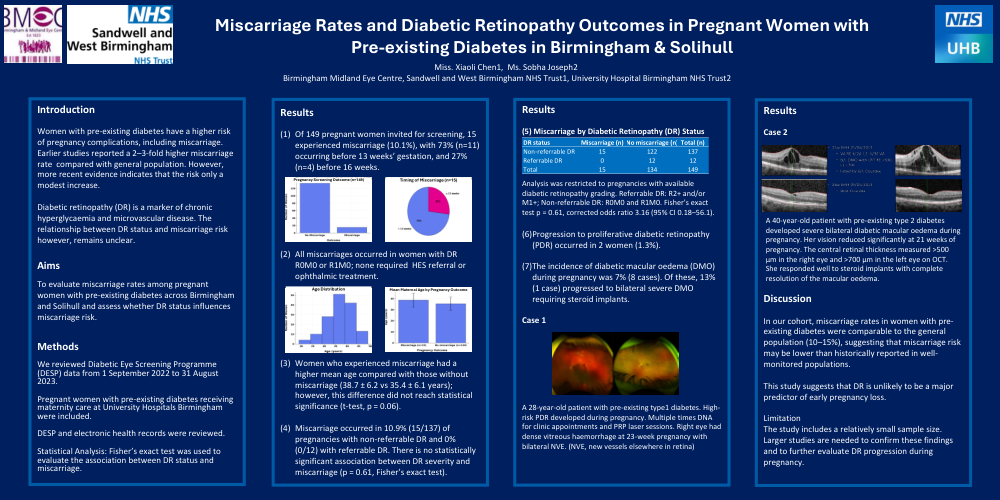
Women with pre-existing diabetes have an increased risk of pregnancy complications, including miscarriage. Earlier studies reported a 2–3-fold higher miscarriage rate in women with diabetes, although recent evidence suggests only a modest increase. The influence of diabetic retinopathy (DR) status on miscarriage risk, however, remains unclear.
Aim
To evaluate miscarriage rates among pregnant women with pre-existing diabetes across Birmingham and Solihull and assess whether DR status influences miscarriage risk.
Methods
We reviewed Diabetic Eye Screening Programme (DESP) data from 1 September 2022 to 31 August 2023. Pregnant women with pre-existing diabetes receiving maternity care at University Hospitals Birmingham were included. DESP and electronic health records were reviewed, and Fisher’s exact test assessed associations between DR status and miscarriage.
Results
Of 149 pregnant women invited for screening, 15 experienced miscarriage (10.1%), with 73% occurring before 13 weeks’ gestation. All miscarriages occurred in women with DR R0M0 or R1M0; none required referral or treatment. Among women completing pregnancy, one (<1%) progressed to proliferative DR. Diabetic macular oedema (DMO) was observed in 8 (7%) cases, with one progressing to bilateral severe DMO requiring steroid implants. Maternal age did not differ significantly between women with and without miscarriage (P>0.05), and there was no significant association between DR status and miscarriage.
Conclusion
In our cohort, miscarriage rates in women with pre-existing diabetes were comparable to the general population (10–15%), suggesting that miscarriage risk may be lower than historically reported in well-monitored populations. DR is unlikely to be a major predictor of pregnancy loss. Larger studies are needed to confirm these findings and to further evaluate DR progression during pregnancy.