296 posters, 7 videos, 13 audios, 14 topics, 10 sessions, 1,019 authors, 259 institutions
ePostersLive by SciGen Technologies S.A. All rights reserved.
RCOphth Annual Congress 2026
18 - 21 May, 2026 | Manchester Central, Manchester

P171
Long-term Anti-VEGF Therapy Outcomes among South Asian Population with Diabetic Macular Oedema in a Real-world Clinical Setting
Poster Presenter
Authors
Part of Topic
Medical retina
Long-term anti-VEGF therapy outcomes among a South Asian population with diabetic macular oedema, in a real-world clinical setting
Background
For over a decade anti-VEGF intravitreal injections have been a first-line treatment for patients with diabetic macular oedema (DMO), improving both structure and function (1).
The prevalence of diabetes amongst patients of South Asian heritage is estimated to be around 22% (2) and yet South Asian patients are under-represented in most clinical trials for DMO (3.1% and 5.2% in the RISE and RIDE trials respectively) – with the majority of participants being Caucasian (3).
Whilst there is evidence that South Asian patients with DMO respond well to anti-VEGF treatment in the first 12 months (4), little is known about their longer-term outcomes. Here we present 5-year data looking at the baseline characteristics and structural and functional outcomes of South Asian patients with DMO, in comparison to a Caucasian cohort.
Method
All patients attending the Bradford Macular Centre and receiving anti-VEGF treatment for diabetic macular oedema were retrospectively identified from an electronic patient database. Patients were then excluded if they did not have ≥5 years of follow up data, had other ocular co-morbidities, had been treated with intravitreal steroid or were not of Caucasian or South Asian ethnic background (self reported).
Data was then retrieved from their electronic patient record on baseline best corrected visual acuity (BCVA), baseline central macular thickness (CMT), age, gender, duration of diabetes, ethnicity, diabetes type (I or II), baseline retinopathy grading and postcode. From the postcode data an index of multiple deprivation (IMD) score was determined from the national 2025 database (https://deprivation.communities.gov.uk/orer 2025). The lower the number the more deprived the neighbourhood.
Additional data was collected for BCVA and CMT at year 1, year 2, year 3, year 4 and year 5, as well as the total number of injections over 5 years and the type of anti-VEGF used. To reduce bias only one eye was selected for analysis from each bilateral patient. This was the first eye to be treated, or the right eye if both eyes were treated on the same day (unless this eye was amblyopic). All eyes were treated according to a treat and extend protocol following 3 loading doses.
Results
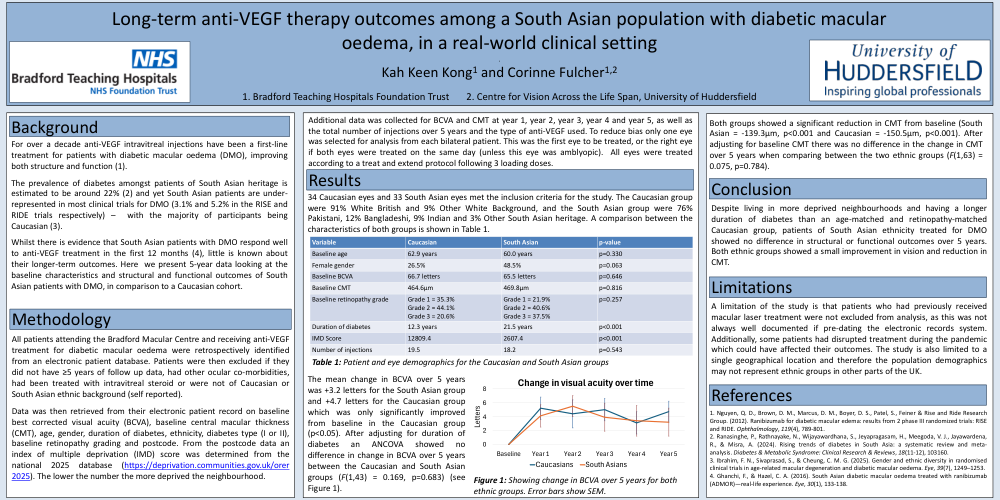
34 Caucasian eyes and 33 South Asian eyes met the inclusion criteria for the study. The Caucasian group were 91% White British and 9% Other White Background, and the South Asian group were 76% Pakistani, 12% Bangladeshi, 9% Indian and 3% Other South Asian heritage. A comparison between the characteristics of both groups is shown in Table 1.
The mean change in BCVA over 5 years was +3.2 letters for the South Asian group and +4.7 letters for the Caucasian group which was only significantly improved from baseline in the Caucasian group (p<0.05). After adjusting for duration of diabetes an ANCOVA showed no difference in change in BCVA over 5 years between the Caucasian and South Asian groups (F(1,43) = 0.169, p=0.683) (see Figure 1).
Both groups showed a significant reduction in CMT from baseline (South Asian = -139.3µm, p<0.001 and Caucasian = -150.5µm, p<0.001). After adjusting for baseline CMT there was no difference in the change in CMT over 5 years when comparing between the two ethnic groups (F(1,63) = 0.075, p=0.784).
Conclusion
Despite living in more deprived neighbourhoods and having a longer duration of diabetes than an age-matched and retinopathy-matched Caucasian group, patients of South Asian ethnicity treated for DMO showed no difference in structural or functional outcomes over 5 years. Both ethnic groups showed a small improvement in vision and reduction in CMT.
Reference
1. Nguyen, Q. D., Brown, D. M., Marcus, D. M., Boyer, D. S., Patel, S., Feiner & Rise and Ride Research Group. (2012). Ranibizumab for diabetic macular edema: results from 2 phase III randomized trials: RISE and RIDE. Ophthalmology, 119(4), 789-801.
2. Ranasinghe, P., Rathnayake, N., Wijayawardhana, S., Jeyapragasam, H., Meegoda, V. J., Jayawardena, R., & Misra, A. (2024). Rising trends of diabetes in South Asia: a systematic review and meta-analysis. Diabetes & Metabolic Syndrome: Clinical Research & Reviews, 18(11-12), 103160.
3. Ibrahim, F. N., Sivaprasad, S., & Cheung, C. M. G. (2025). Gender and ethnic diversity in randomised clinical trials in age-related macular degeneration and diabetic macular oedema. Eye, 39(7), 1249–1253.
4. Ghanchi, F., & Hazel, C. A. (2016). South Asian diabetic macular oedema treated with ranibizumab (ADMOR)—real-life experience. Eye, 30(1), 133-138.