296 posters, 7 videos, 13 audios, 14 topics, 10 sessions, 1,019 authors, 259 institutions
ePostersLive by SciGen Technologies S.A. All rights reserved.
RCOphth Annual Congress 2026
18 - 21 May, 2026 | Manchester Central, Manchester

P169
Impact of the New R2L/R2H Diabetic Retinopathy Grading System on Hospital Referrals and Service Workload: A Two-Year Comparative Study
Poster Presenter
Authors
Part of Topic
Medical retina
Impact of the New R2L/R2H Diabetic Retinopathy Grading System on Hospital Referrals and Service workload: A Two-Year Comparative Study.
Reham Shehada, Leah Oconnell, Kimberley Turner, Chintan Sanghvi
Introduction
- In October 2024, the Diabetic Eye Screening Programme introduced a revised national referral pathway for patients graded as R2 pre-proliferative diabetic retinopathy.
- Previously, referral practice varied between programmes:
- Some referred all R2 patients to the Hospital Eye Service (HES).
- Others referred only patients considered to be at higher risk.
- This variation created inconsistency between Diabetic Eye Screening Programmes and contributed to avoidable capacity pressure within HES.
- The revised pathway introduced a two-tier R2 grading system:
- R2L: R2 lower-risk pre-proliferative diabetic retinopathy, usually retained within digital surveillance if there is no referable maculopathy.
- R2H: R2 higher-risk pre-proliferative diabetic retinopathy, referred to HES because of higher risk of progression.
- Ungradable R2: Retinal images are of insufficient quality to confidently assign the R2 grade or exclude higher-risk features; these cases may require HES assessment depending on local pathway and clinical concern.
- R2L is defined by the presence of any one of the following lower-risk R2 features:
- 8 or more blot haemorrhages across the four quadrants.
- More than 20 haemorrhages or microaneurysms of any size per quadrant in 1–3 quadrants.
- Venous beading in one quadrant.
- Intraretinal microvascular abnormalities (IRMA) smaller than ½ disc diameter in any quadrant.
- R2H is based on the 4-2-1 principles, where the presence of any one of the following features is sufficient to classify the eye as R2H:
- More than 20 haemorrhages or microaneurysms in each of the four quadrants.
- Venous beading in two or more quadrants.
- IRMA larger than ½ disc diameter in one or more quadrants.
- This service evaluation assessed the impact of the revised R2L/R2H pathway at East Lancashire Hospitals NHS Trust (ELHT) on:
- Referral activity to HES.
- Agreement between screening and hospital assessment.
- Hospital management outcomes.
Methods
- A retrospective comparative service evaluation was conducted within the Diabetic Eye Screening Programme at ELHT
- Screening and hospital outcomes were reviewed before and after introduction of the revised R2L/R2H referral pathway.
- Pre-implementation cohort:
- Screening period: September 2023 to September 2024.
- Included patients graded R2M0 or R2M1 under the previous DESP classification.
- These patients were referred to the Hospital Eye Service under the previous pathway.
- Post-implementation cohort:
- Screening period: October 2024 to November 2025.
- Included patients graded R2HM0, R2HM1, or ungradable R2 cases referred to HES.
- Included R2LM0 patients retained within screening surveillance.
- Data sources:
- Local diabetic eye screening databases.
- Hospital clinical records.
- Analysis was based on the worst eye classification, in keeping with standard DESP referral criteria.
- Collected variables included:
- Screening grade.
- Maculopathy status.
- Hospital grading
- Management outcome.
- Referral activity before and after implementation was compared to assess the impact of the pathway change on HES workload.
- Agreement between screening grade and hospital diagnosis was reviewed to assess referral accuracy.
- Hospital documentation was reviewed to assess whether the revised terminology, particularly R2L and R2H, was used consistently after implementation.
Results
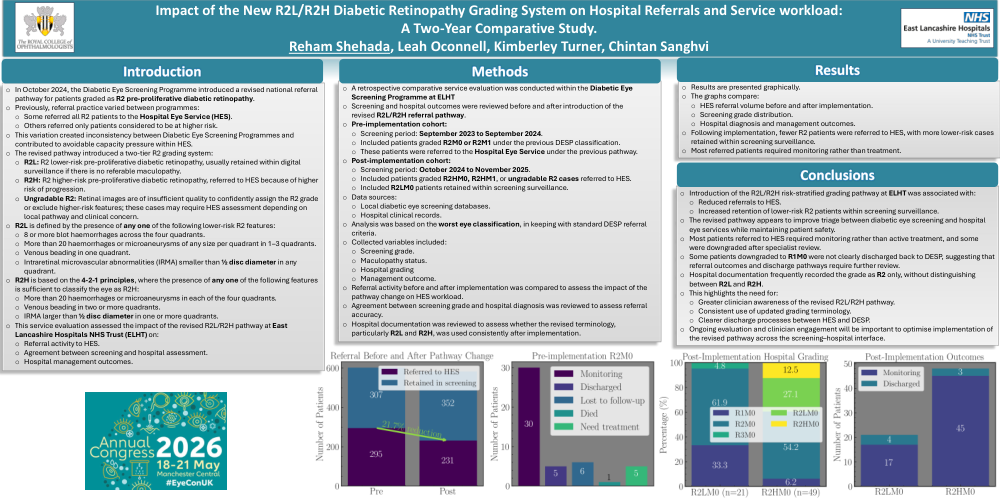
- Results are presented graphically.
- The graphs compare:
- HES referral volume before and after implementation.
- Screening grade distribution.
- Hospital diagnosis and management outcomes.
- Following implementation, fewer R2 patients were referred to HES, with more lower-risk cases retained within screening surveillance.
- Most referred patients required monitoring rather than treatment.
Conclusion
- Introduction of the R2L/R2H risk-stratified grading pathway at ELHT was associated with:
- Reduced referrals to HES.
- Increased retention of lower-risk R2 patients within screening surveillance.
- The revised pathway appears to improve triage between diabetic eye screening and hospital eye services while maintaining patient safety.
- Most patients referred to HES required monitoring rather than active treatment, and some were downgraded after specialist review.
- Some patients downgraded to R1M0 were not clearly discharged back to DESP, suggesting that referral outcomes and discharge pathways require further review.
- Hospital documentation frequently recorded the grade as R2 only, without distinguishing between R2L and R2H.
- This highlights the need for:
- Greater clinician awareness of the revised R2L/R2H pathway.
- Consistent use of updated grading terminology.
- Clearer discharge processes between HES and DESP.
- Ongoing evaluation and clinician engagement will be important to optimise implementation of the revised pathway across the screening–hospital interface.