296 posters, 7 videos, 13 audios, 14 topics, 10 sessions, 1,019 authors, 259 institutions
ePostersLive by SciGen Technologies S.A. All rights reserved.
RCOphth Annual Congress 2026
18 - 21 May, 2026 | Manchester Central, Manchester

P160
Efficacy of Faricimab versus Aflibercept-8mg in patients with treatment na?ve diabetic macular oedema. Real World Outcomes.
Poster Presenter
Authors
Kuan-Yin Wu, Hanna Tsaberiaba, Mohaimen Al-Zubaidy, Will Evans, Michael Grinton, Ajay Kotagiri, David Steel, Maged Habib
Affiliations
Sunderland Eye Infirmary, South Tyneside and Sunderland NHS Foundation Trust, Northern Ophthalmic Research and Innovation Institute (NORI), University of Sunderland, Sunderland Eye Infirmary, South Tyneside and Sunderland NHS Foundation Trust; Northern Ophthalmic Research and Innovation Institute (NORI); Newcastle University Biosciences Institute
Part of Topic
Medical retina
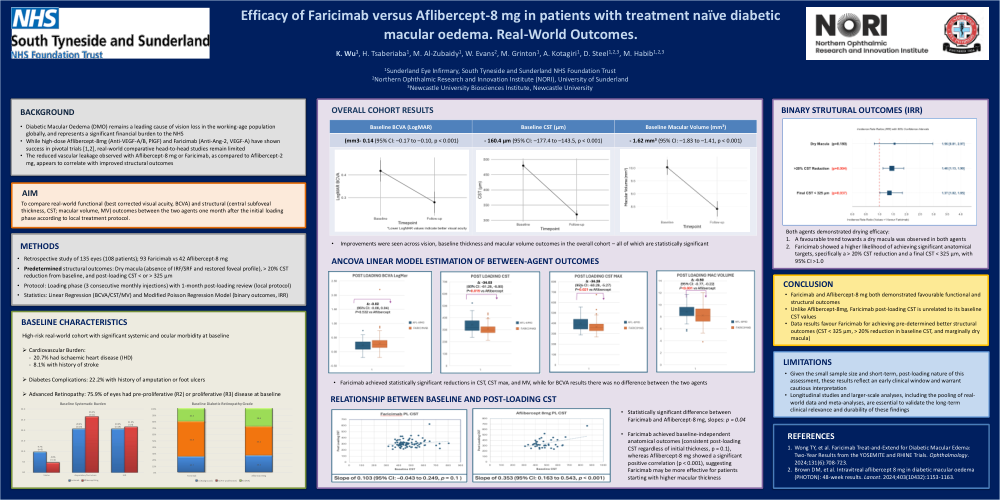
Efficacy of Faricimab versus Aflibercept-8 mg in patients with treatment naïve diabetic macular oedema. Real-World Outcomes.
K. Wu1, H. Tsaberiaba1, M. Al-Zubaidy1, W. Evans2, M. Grinton1, A. Kotagiri1, D. Steel1,2,3, M. Habib1,2,3
1Sunderland Eye Infirmary, South Tyneside and Sunderland NHS Foundation Trust
2Northern Ophthalmic Research and Innovation Institute (NORI), University of Sunderland
3Newcastle University Biosciences Institute, Newcastle University
BACKGROUND
Diabetic Macular Oedema (DMO) remains a leading cause of vision loss in the working-age population globally, and represents a significant financial burden to the NHS. While high-dose Aflibercept-8mg (Anti-VEGF-A/B, PlGF) and Faricimab (Anti-Ang-2, VEGF-A) have shown success in pivotal trials [1,2], real-world comparative head-to-head studies remain limited. The reduced vascular leakage observed with Aflibercept-8 mg or Faricimab, as compared to Aflibercept-2 mg, appears to correlate with improved structural outcomes.
AIM
To compare real-world functional (best corrected visual acuity, BCVA) and structural (central subfoveal thickness, CST; macular volume, MV) outcomes between the two agents one month after the initial loading phase according to local treatment protocol.
METHODS
• Retrospective study of 135 eyes (108 patients); 93 Faricimab vs 42 Aflibercept-8 mg
• Predetermined structural outcomes: Dry macula (absence of IRF/SRF and restored foveal profile), > 20% CST reduction from baseline, and post-loading CST < or > 325 µm
• Protocol: Loading phase (3 consecutive monthly injections) with 1-month post-loading review (local protocol)
• Statistics: Linear Regression (BCVA/CST/MV) and Modified Poisson Regression Model (binary outcomes, IRR)
BASELINE CHARACTERISTICS
High-risk real-world cohort with significant systemic and ocular morbidity at baseline
Cardiovascular Burden:
- 20.7% had ischaemic heart disease (IHD)
- 8.1% with history of stroke
Diabetes Complications: 22.2% with history of amputation or foot ulcers
Advanced Retinopathy: 75.9% of eyes had pre-proliferative (R2) or proliferative (R3) disease at baseline
OVERALL COHORT RESULTS
Improvements were seen across vision, baseline thickness and macular volume outcomes in the overall cohort – all of which are statistically significant
ANCOVA LINEAR MODEL ESTIMATION OF BETWEEN-AGENT OUTCOMES
Faricimab achieved statistically significant reductions in CST, CST max, and MV, while for BCVA results there was no difference between the two agents
RELATIONSHIP BETWEEN BASELINE AND POST-LOADING CST
Statistically significant difference between Faricimab and Aflibercept-8 mg, slopes: p = 0.04
Faricimab achieved baseline-independent anatomical outcomes (consistent post-loading CST regardless of initial thickness, p = 0.1), whereas Aflibercept-8 mg showed a significant positive correlation (p < 0.001), suggesting Faricimab may be more effective for patients starting with higher macular thickness
BINARY STRUTURAL OUTCOMES (IRR)
Both agents demonstrated drying efficacy:
1.A favourable trend towards a dry macula was observed in both agents
2.Faricimab showed a higher likelihood of achieving significant anatomical targets, specifically a > 20% CST reduction and a final CST < 325 µm, with 95% CI >1.0
CONCLUSION
Faricimab and Aflibercept-8 mg both demonstrated favourable functional and structural outcomes. Unlike Aflibercept-8mg, Faricimab post-loading CST is unrelated to its baseline CST values. Data results favour Faricimab for achieving pre-determined better structural outcomes (CST < 325 µm, > 20% reduction in baseline CST, and marginally dry macula).
LIMITATIONS
Given the small sample size and short-term, post-loading nature of this assessment, these results reflect an early clinical window and warrant cautious interpretation. Longitudinal studies and larger-scale analyses, including the pooling of real-world data and meta-analyses, are essential to validate the long-term clinical relevance and durability of these findings.
REFERENCES
1. Wong TY, et al. Faricimab Treat-and-Extend for Diabetic Macular Edema: Two-Year Results from the YOSEMITE and RHINE Trials. Ophthalmology. 2024;131(6):708-723.
2. Brown DM, et al. Intravitreal aflibercept 8 mg in diabetic macular oedema (PHOTON): 48-week results. Lancet. 2024;403(10432):1153-1163.