296 posters, 7 videos, 13 audios, 14 topics, 10 sessions, 1,019 authors, 259 institutions
ePostersLive by SciGen Technologies S.A. All rights reserved.
RCOphth Annual Congress 2026
18 - 21 May, 2026 | Manchester Central, Manchester

P154
Do treatment-naive proliferative diabetic retinopathy patients in York and Scarborough NHS Foundation Trust receive timely panretinal photocoagulation?
Poster Presenter
Authors
Part of Topic
Medical retina
Do treatment-naive proliferative diabetic retinopathy patients in York and Scarborough NHS Foundation Trust receive timely panretinal photocoagulation?
Background
Panretinal photocoagulation (PRP) has been an established treatment for the prevention of severe vision loss due to proliferative diabetic retinopathy (PDR) for over 40 years.1 Standard PRP laser treatment is typically delivered in 2 sessions with additional laser added only if needed. Treatment should be given promptly before complications such as vitreous haemorrhage or retinal detachment limit effectiveness.1
Aims
To assess timeliness of PRP delivery, in accordance with NICE guidance NG242 (1.5.3)2:
- 1st PRP session should be performed within 4 weeks of the decision to treat (DTT). If unable, within 6 weeks.
- Treatment should be completed within 4 weeks of the 1st.
To assess the factors that contribute to suboptimal timeliness of PRP delivery.
Methods
The electronic records of all diabetic patients who received PRP laser in six months between 01/07/24-31/12/24 were reviewed. Patients were excluded if: PDR was not the indication for PRP, any previous PRP to the same eye, any medical reason that laser needed to be delayed. The dates for the decision to treat with PRP, 1st session, 2nd session and 3rd session (if needed) were recorded and the number of days between each were calculated.
Results
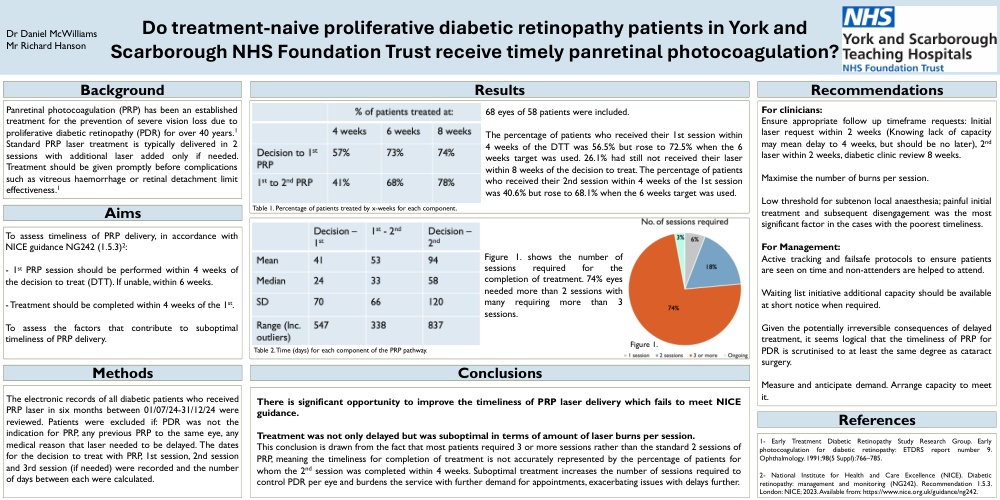
68 eyes of 58 patients were included.
The percentage of patients who received their 1st session within 4 weeks of the DTT was 56.5% but rose to 72.5% when the 6 weeks target was used. 26.1% had still not received their laser within 8 weeks of the decision to treat. The percentage of patients who received their 2nd session within 4 weeks of the 1st session was 40.6% but rose to 68.1% when the 6 weeks target was used.
Figure 1. shows the number of sessions required for the completion of treatment. 74% eyes needed more than 2 sessions with many requiring more than 3 sessions.
Conclusions
There is significant opportunity to improve the timeliness of PRP laser delivery which fails to meet NICE guidance.
Treatment was not only delayed but was suboptimal in terms of amount of laser burns per session.
This conclusion is drawn from the fact that most patients required 3 or more sessions rather than the standard 2 sessions of PRP, meaning the timeliness for completion of treatment is not accurately represented by the percentage of patients for whom the 2nd session was completed within 4 weeks. Suboptimal treatment increases the number of sessions required to control PDR per eye and burdens the service with further demand for appointments, exacerbating issues with delays further.
Recommendations
For clinicians:
Ensure appropriate follow up timeframe requests: Initial laser request within 2 weeks (Knowing lack of capacity may mean delay to 4 weeks, but should be no later), 2nd laser within 2 weeks, diabetic clinic review 8 weeks.
Maximise the number of burns per session.
Low threshold for subtenon local anaesthesia; painful initial treatment and subsequent disengagement was the most significant factor in the cases with the poorest timeliness.
For Management:
Active tracking and failsafe protocols to ensure patients are seen on time and non-attenders are helped to attend.
Waiting list initiative additional capacity should be available at short notice when required.
Given the potentially irreversible consequences of delayed treatment, it seems logical that the timeliness of PRP for PDR is scrutinised to at least the same degree as cataract surgery.
Measure and anticipate demand. Arrange capacity to meet it.
References
1- Early Treatment Diabetic Retinopathy Study Research Group. Early photocoagulation for diabetic retinopathy: ETDRS report number 9. Ophthalmology. 1991;98(5 Suppl):766–785.
2- National Institute for Health and Care Excellence (NICE). Diabetic retinopathy: management and monitoring (NG242). Recommendation 1.5.3. London: NICE; 2023. Available from: https://www.nice.org.uk/guidance/ng242.