296 posters, 7 videos, 13 audios, 14 topics, 10 sessions, 1,019 authors, 259 institutions
ePostersLive by SciGen Technologies S.A. All rights reserved.
RCOphth Annual Congress 2026
18 - 21 May, 2026 | Manchester Central, Manchester

P150
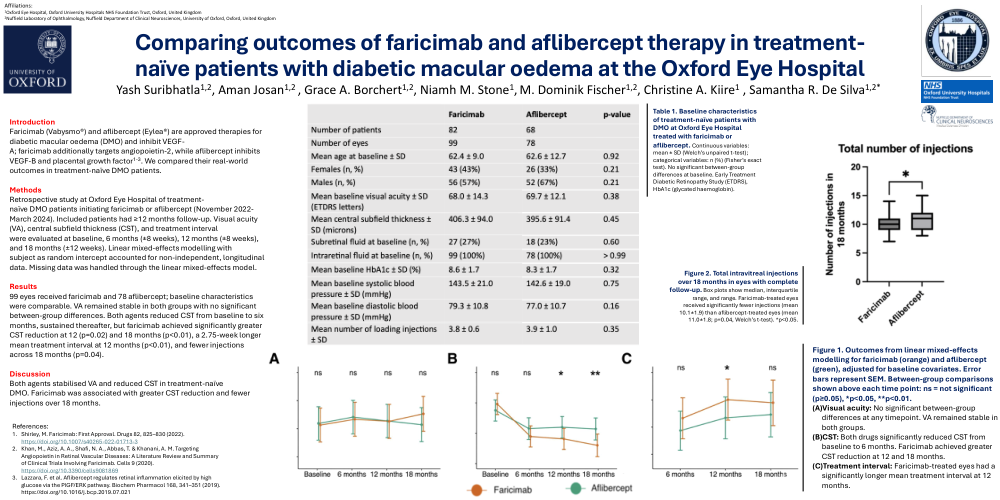
Comparing outcomes of faricimab and aflibercept therapy in treatment-na?ve patients with diabetic macular oedema at the Oxford Eye Hospital
Poster Presenter
Authors
Yash Suribhatla, Aman Josan, Grace Borchert, Niamh Stone, Dominik Fischer, Christine Kiire, Samantha De Silva
Affiliations
null,
Part of Topic
Medical retina
Introduction
Faricimab (Vabysmo®) and aflibercept (Eylea®) are approved therapies for diabetic macular oedema (DMO) and inhibit VEGF-A; faricimab additionally targets angiopoietin-2, while aflibercept inhibits VEGF-B and placental growth factor1-3. We compared their real-world outcomes in treatment-naïve DMO patients.
Methods
Retrospective study at Oxford Eye Hospital of treatment-naïve DMO patients initiating faricimab or aflibercept (November 2022-March 2024). Included patients had ≥12 months follow-up. Visual acuity (VA), central subfield thickness (CST), and treatment interval were evaluated at baseline, 6 months (±8 weeks), 12 months (±8 weeks), and 18 months (±12 weeks). Linear mixed-effects modelling with subject as random intercept accounted for non-independent, longitudinal data. Missing data was handled through the linear mixed-effects model.
Results
99 eyes received faricimab and 78 aflibercept; baseline characteristics were comparable. VA remained stable in both groups with no significant between-group differences. Both agents reduced CST from baseline to six months, sustained thereafter, but faricimab achieved significantly greater CST reduction at 12 (p=0.02) and 18 months (p<0.01), a 2.75-week longer mean treatment interval at 12 months (p<0.01), and fewer injections across 18 months (p=0.04).
Discussion
Both agents stabilised VA and reduced CST in treatment-naïve DMO. Faricimab was associated with greater CST reduction and fewer injections over 18 months.
Table 1. Baseline characteristics of treatment-naïve patients with DMO at Oxford Eye Hospital treated with faricimab or aflibercept. Continuous variables: mean ± SD (Welch’s unpaired t-test); categorical variables: n (%) (Fisher’s exact test). No significant between-group differences at baseline. Early Treatment Diabetic Retinopathy Study (ETDRS), HbA1c (glycated haemoglobin).
Figure 1. Outcomes from linear mixed-effects modelling for faricimab (orange) and aflibercept (green), adjusted for baseline covariates. Error bars represent SEM. Between-group comparisons shown above each time point: ns = not significant (p≥0.05), *p<0.05, **p<0.01.
Figure 2. Total intravitreal injections over 18 months in eyes with complete follow-up. Box plots show median, interquartile range, and range. Faricimab-treated eyes received significantly fewer injections (mean 10.1±1.9) than aflibercept-treated eyes (mean 11.0±1.8; p=0.04, Welch’s t-test). *p<0.05.