296 posters, 7 videos, 13 audios, 14 topics, 10 sessions, 1,019 authors, 259 institutions
ePostersLive by SciGen Technologies S.A. All rights reserved.
RCOphth Annual Congress 2026
18 - 21 May, 2026 | Manchester Central, Manchester

P148
Clinical outcomes of intraocular inflammation following intravitreal faricimab for neovascular age-related macular degeneration: a single-centre retrospective study.
Poster Presenter
Authors
Christopher Stewart, Ahmed Al-Janabi, Jaskaran Singh Bhangu, Parinita Swarnkar, Gwyn Williams, Kevin Gallagher
Affiliations
Faculty of Medicine, Health, and Life Science, Swansea University, Swansea, Wales, UK, Ophthalmology department, Singleton Hospital, Swansea Bay University Health Board, Swansea, Wales, UK, Cwm Taf Morgannwg University Health Board, Royal Glamorgan Hospital, Llantrisant, UK
Part of Topic
Medical retina
Intraocular inflammation (IOI) represents an uncommon but clinically important adverse event associated with intravitreal anti-vascular endothelial growth factor (anti-VEGF) therapy. These inflammatory episodes range from mild acute anterior uveitis to occlusive retinal vasculitis and major visual loss. The incidence and severity of inflammation differs between anti-VEGF agents. Faricimab, a bispecific antibody targeting both VEGF-A and angiopoietin-2, for which effiacy has been demonstrated in the pivotal phase III trials TENAYA & LUCERNE has been shown to sit around 2% for treatment related IOI.(1) The range of the incidence of IOI following Faricimab has been reported by further trials lying between 0.19 to 0.78% per injection.2,3
Following wider clinical adoption of Faricimab, several real-world case reports and small series have described cases of anterior uveitis, vitritis, and, rarely, occlusive retinal vasculitis following Faricimab injection.(2,4-7) Importantly, there is limited real-world evidence on the clinical course and visual outcomes in this context. To address these gaps, we conducted a single-centre retrospective study at Singleton Hospital, Swansea, UK, analysing all cases of IOI occurring after intravitreal Faricimab for nAMD over a two-year period (June 2023 – August 2025). The primary aims of the study were:
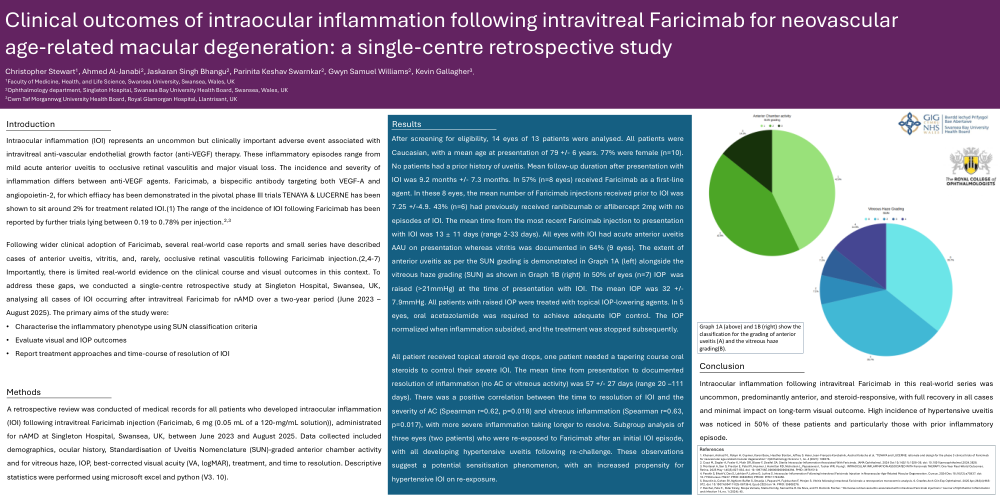
After screening for eligibility, 14 eyes of 13 patients were analysed. All patients were Caucasian, with a mean age at presentation of 79 +/- 6 years. 77% were female (n=10). No patients had a prior history of uveitis. Mean follow-up duration after presentation with IOI was 9.2 months +/- 7.3 months. In 57% (n=8 eyes) received Faricimab as a first-line agent. In these 8 eyes, the mean number of Faricimab injections received prior to IOI was 7.25 +/-4.9. 43% (n=6) had previously received ranibizumab or aflibercept 2mg with no episodes of IOI. The mean time from the most recent Faricimab injection to presentation with IOI was 13 ± 11 days (range 2-33 days). All eyes with IOI had acute anterior uveitis AAU on presentation whereas vitritis was documented in 64% (9 eyes). The extent of anterior uveitis as per the SUN grading is demonstrated in Graph 1A (left) alongside the vitreous haze grading (SUN) as shown in Graph 1B (right) In 50% of eyes (n=7) IOP was raised (>21mmHg) at the time of presentation with IOI. The mean IOP was 32 +/- 7.9mmHg. All patients with raised IOP were treated with topical IOP-lowering agents. In 5 eyes, oral acetazolamide was required to achieve adequate IOP control. The IOP normalized when inflammation subsided, and the treatment was stopped subsequently.
All patient received topical steroid eye drops, one patient needed a tapering course oral steroids to control their severe IOI. The mean time from presentation to documented resolution of inflammation (no AC or vitreous activity) was 57 +/- 27 days (range 20 –111 days). There was a positive correlation between the time to resolution of IOI and the severity of AC (Spearman r=0.62, p=0.018) and vitreous inflammation (Spearman r=0.63, p=0.017), with more severe inflammation taking longer to resolve. Subgroup analysis of three eyes (two patients) who were re-exposed to Faricimab after an initial IOI episode, with all developing hypertensive uveitis following re-challenge. These observations suggest a potential sensitisation phenomenon, with an increased propensity for hypertensive IOI on re-exposure.
Intraocular inflammation following intravitreal Faricimab in this real-world series was uncommon, predominantly anterior, and steroid-responsive, with full recovery in all cases and minimal impact on long-term visual outcome. High incidence of hypertensive uveitis was noticed in 50% of these patients and particularly those with prior inflammatory episode.