296 posters, 7 videos, 13 audios, 14 topics, 10 sessions, 1,019 authors, 259 institutions
ePostersLive by SciGen Technologies S.A. All rights reserved.
RCOphth Annual Congress 2026
18 - 21 May, 2026 | Manchester Central, Manchester

P136
Analysis of ABCA4 genotypes in patients with the Arg2107His variant prevalent in those of African ancestry
Poster Presenter
Authors
Abdallah Abbas, Siying Lin, Gavin Arno, Anthony G Robson, Michel Michaelides, Andrew Webster, Omar Mahroo
Affiliations
NIHR Biomedical Research Centre at Moorfields Eye Hospital and the UCL institute of Ophthalmology, London, United Kingdom, NIHR Biomedical Research Centre at Moorfields Eye Hospital and the UCL institute of Ophthalmology, London, United Kingdom; Division of Evolution, Infection and Genomics, School of Biological Sciences, Faculty of Biolo, University College London Institute of Ophthalmology, London, England, United Kingdom; Greenwood Genetic Center, Greenwood, SC, United States
Part of Topic
Medical retina
Analysis of ABCA4 genotypes in patients with the Arg2107His variant prevalent in those of African ancestry
Purpose:
The ABCA4 p.Arg2107His missense variant is regarded as a disease-associated allele, but is also present in around 1 in 50 genomes of individuals of African ancestry. We explored ABCA4 genotypes in patients diagnosed with ABCA4-retinopathy in association with this variant.
Methods:
Patients (from two UK centres) diagnosed with ABCA4-retinopathy who carried this variant on at least one allele were included. Genotypes were analysed to investigate whether any patients were homozygous for this variant and also to explore the severity grading of the other ABCA4 allele in patients who were apparently compound heterozygotes. Demographic and clinical data were also noted.
Results:
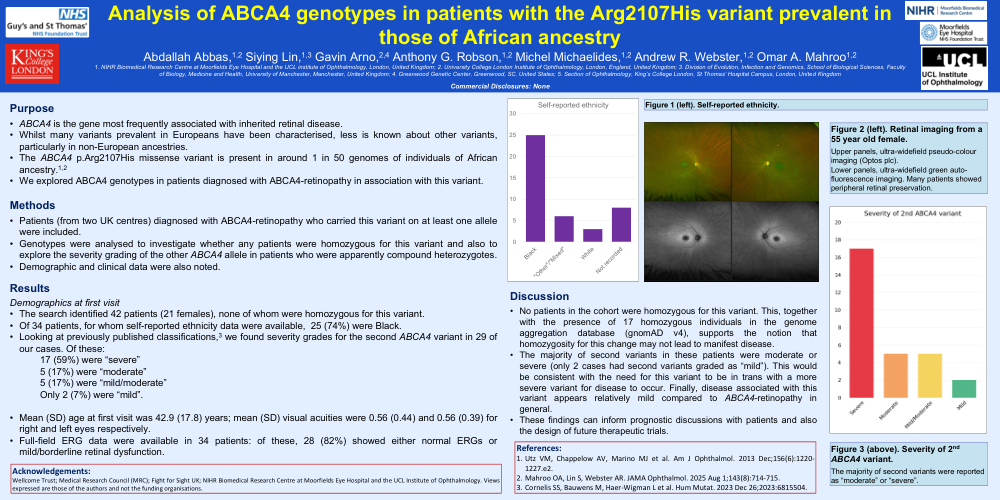
The search identified 42 patients (21 females), none of whom were homozygous for this variant. Of 34 patients, for whom self-reported ethnicity data were available, 25 (74%) were Black. Looking at previous publications, we found severity grades for the second ABCA4 variant in 29 cases. Of these, 17 (59%) were “severe”, 5 (17%) were “moderate”, 5 (17%) were “mild/moderate”, and only 2 (7%) were “mild”. Mean (SD) age at first visit was 42.9 (17.8) years; mean (SD) visual acuities were 0.56 (0.44) and 0.56 (0.39) for right and left eyes respectively. Full-field ERG data were available in 34 patients: of these, 28 (82%) showed either normal ERGs or mild/borderline retinal dysfunction.
Conclusions:
No patients in the cohort were homozygous for this variant. This, together with the presence of 17 homozygous individuals in the genome aggregation database (gnomAD v4), supports the notion that homozygosity for this change may not lead to manifest disease. Also, the majority of second variants in these patients were moderate or severe (only 2 cases had second variants graded as mild). This would be consistent with the need for this variant to be in trans with a more severe variant for disease to occur. Finally, disease associated with this variant appears relatively mild compared to ABCA4-retinopathy in general.