296 posters, 7 videos, 13 audios, 14 topics, 10 sessions, 1,019 authors, 259 institutions
ePostersLive by SciGen Technologies S.A. All rights reserved.
RCOphth Annual Congress 2026
18 - 21 May, 2026 | Manchester Central, Manchester

P128
Visual outcomes and patient satisfaction with a new enhanced monofocal intraocular lens in glaucoma patients�
Poster Presenter
Authors
Part of Topic
Glaucoma
Visual outcomes and patient satisfaction with a new enhanced monofocal intraocular lens in glaucoma patients
Oluwademilade Osawe, Pouya Alaghband
Introduction:
The European Society of Cataract & Refractive Surgeons (ESCRS) Functional Vision Working Group recently emphasized that intermediate vision plays a crucial role in modern life(1). Consequently, enhanced monofocal intraocular lenses(IOLs), such as the Tecnis Eyehance, were designed to provide improved intermediate and functional near vision while maintaining distance visual performance. This is achieved by a modified central optic to extend depth of focus with a softer landing zone relative to traditional monofocal lenses. Glaucoma is known to be associated with visual impairment, reduced contrast sensitivity and visual field loss. These factors may influence postoperative performance of conventional premium diffractive IOLs. Real-world outcomes of Eyehance IOLs in the general cataract population have shown improved intermediate and near visual acuity, but evidence in glaucoma patients is scarce(2). This prospective real-world study evaluates early visual outcomes and patient satisfaction following Eyehance IOL implantation in a glaucoma cohort.
Methods:
This study included all glaucoma patients of any severity undergoing cataract surgery with implantation of Tecnis Eyehance IOLs (J&J) between September 2025 and January 2026. Data collected included pre-operative and post-operative best-corrected distance visual acuity (BCVA), unaided distance (UDVA), intermediate (UIVA) and near visual acuity (UNVA). Vision was recorded in logMAR (distance) and N-notation (intermediate/near), pre-operatively and four weeks post-operatively.
Patient satisfaction and ability to perform everyday visual tasks was assessed using the Catquest-9SF structured questionnaire.
Results:
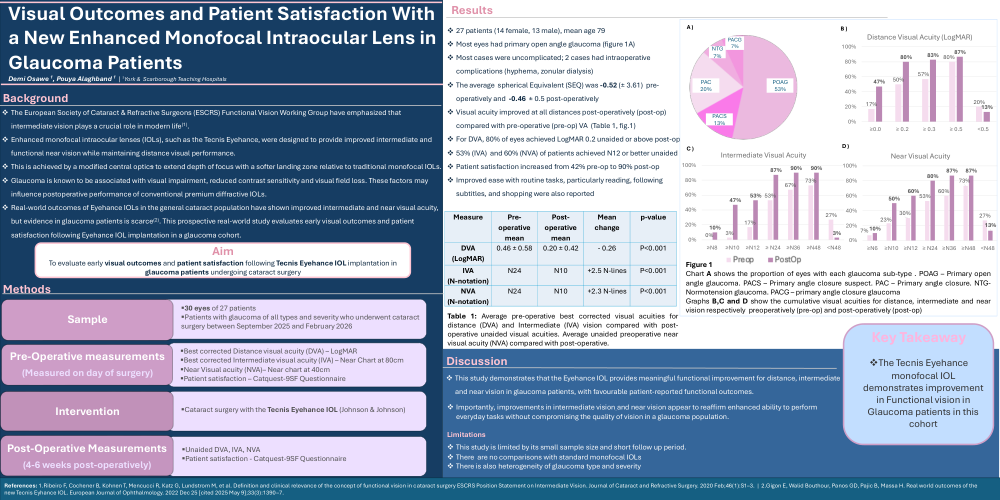
Thirty eyes of twenty-seven patients were included. Most eyes had primary open-angle glaucoma, with a mean patient age of 79 years.
Distance vision improved, with mean change between pre-operative BCVA and post-operative UDVA of -0.3 logMAR (p<0.001), demonstrating meaningful functional gains without correction.
Intermediate visual acuity improved by a mean of 2.5 N-lines (p<0.001), with most eyes improving from approximately N18–N48 pre-operatively to N8–N36 post-operatively.
Near visual acuity improved by a mean of 2.3 N-lines (p<0.001), with 60% of eyes reading ≥ N12 post-operatively, reflecting clinically useful reading vision.
Ninety percent of participants expressed overall satisfaction with their vision post-operatively. They reported improved ease with routine tasks, particularly reading, following subtitles, and shopping. No intra-operative or post-operative complications were noted.
Conclusion:
This study demonstrates that the Eyehance IOL provides meaningful functional improvement for distance, intermediate and near vision in glaucoma patients, with favourable patient-reported functional outcomes. Importantly, improvements in intermediate vision and near vision appear to reaffirm enhanced ability to perform everyday tasks without compromising the quality of vision in a glaucoma population.