296 posters, 7 videos, 13 audios, 14 topics, 10 sessions, 1,019 authors, 259 institutions
ePostersLive by SciGen Technologies S.A. All rights reserved.
RCOphth Annual Congress 2026
18 - 21 May, 2026 | Manchester Central, Manchester

P125
Three-Year Outcomes of the First UK Series of MINIject Supraciliary Implants in Medically Uncontrolled Glaucoma: A Retrospective Real-World Analysis
Poster Presenter
Authors
Dimitrios Lolos, Aadil Hussain, Maria Pantelidou, Ihsan Fazal, Jeremy Tan, Daniel Lindfield, Neeru Vallabh, Gerasimos Lascaratos, Chrysostomos Dimitriou
Affiliations
Colchester Eye Centre, Ipswich Hospital, Prince of Wales Hospital, Farnham Eye Care, Royal Liverpool University Hospital, King’s College Hospital
Part of Topic
Glaucoma
Purpose:
This study evaluates the 3-year real-world efficacy and safety of the MINIject supraciliary implant in reducing intraocular pressure and medication use in medically uncontrolled glaucoma.
Methods:
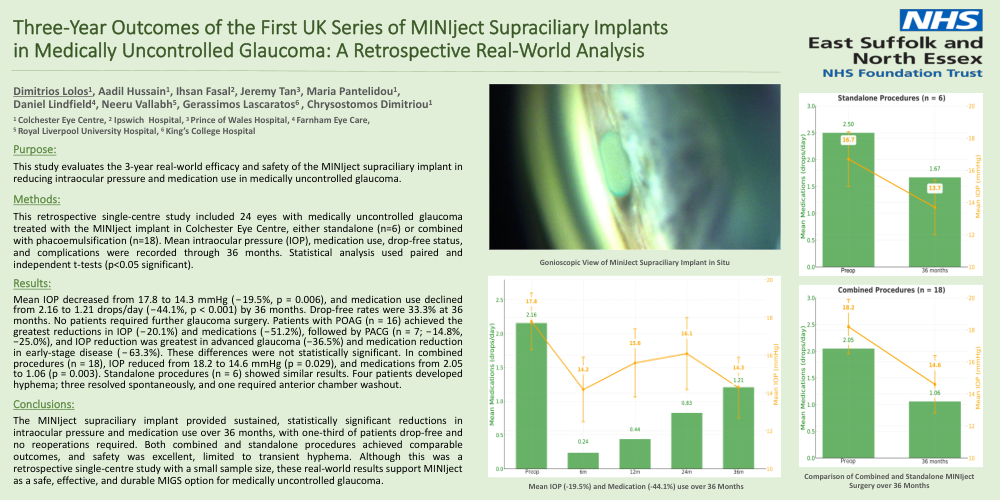
This retrospective single-centre study included 24 eyes with medically uncontrolled glaucoma treated with the MINIject implant in Colchester Eye Centre, either standalone (n=6) or combined with phacoemulsification (n=18). Mean intraocular pressure (IOP), medication use, drop-free status, and complications were recorded through 36 months. Statistical analysis used paired and independent t-tests (p<0.05 significant).
Results:
Mean IOP decreased from 17.8 to 14.3 mmHg (−19.5%, p = 0.006), and medication use declined from 2.16 to 1.21 drops/day (−44.1%, p < 0.001) by 36 months. Drop-free rates were 33.3% at 36 months. No patients required further glaucoma surgery. Patients with POAG (n = 16) achieved the greatest reductions in IOP (−20.1%) and medications (−51.2%), followed by PACG (n = 7; −14.8%, −25.0%), and IOP reduction was greatest in advanced glaucoma (−36.5%) and medication reduction in early-stage disease (−63.3%). These differences were not statistically significant. In combined procedures (n = 18), IOP reduced from 18.2 to 14.6 mmHg (p = 0.029), and medications from 2.05 to 1.06 (p = 0.003). Standalone procedures (n = 6) showed similar results. Four patients developed hyphema; three resolved spontaneously, and one required anterior chamber washout.
Conclusions:
The MINIject supraciliary implant provided sustained, statistically significant reductions in intraocular pressure and medication use over 36 months, with one-third of patients drop-free and no reoperations required. Both combined and standalone procedures achieved comparable outcomes, and safety was excellent, limited to transient hyphema. Although this was a retrospective single-centre study with a small sample size, these real-world results support MINIject as a safe, effective, and durable MIGS option for medically uncontrolled glaucoma.