296 posters, 7 videos, 13 audios, 14 topics, 10 sessions, 1,019 authors, 259 institutions
ePostersLive by SciGen Technologies S.A. All rights reserved.
RCOphth Annual Congress 2026
18 - 21 May, 2026 | Manchester Central, Manchester

P119
Outcomes of Micropulse Versus Continuous-Wave Transscleral Cyclophotocoagulation: A Systematic Review and Meta-Analysis
Poster Presenter
Part of Topic
Glaucoma
Outcomes of Micropulse Versus Continuous-Wave Transscleral Cyclophotocoagulation: A Systematic Review and Meta-Analysis
Amelia Rees1, Mohammad Saleki2, Hosam Aglam3, Ahmed Al-Nahrawy4
- St George's Hospitals NHS Foundaton Trust 2. East Lancashire NHS Foundation Trust, 3. Manchester Royal Eye Hospital, 4. Western Eye Hospital
- Glaucoma refractory to medical therapy may require cyclodestructive procedures
- Continuous-wave TSCPC (CW-TSCPC) is effective but associated with collateral tissue damage
- Micropulse TSCPC (M-TSCPC) delivers laser energy intermittently, potentially improving safety
- Comparative effectiveness between modalities remains uncertain
- Objective: To compare outcomes of M-TSCPC vs CW-TSCPC in uncontrolled glaucoma
2. METHODS
- Systematic review of MEDLINE, EMBASE, EMCARE, CINAHL, PubMed, Cochrane
- PRISMA-guided methodology
- Included: RCTs + comparative observational studies
- Outcomes:
- Primary: Treatment success, IOP (3 & 12 months)
- Secondary: Medications, retreatment
- Meta-analysis: Random-effects models
- Risk of bias: ROBINS-I
3. RESULTS
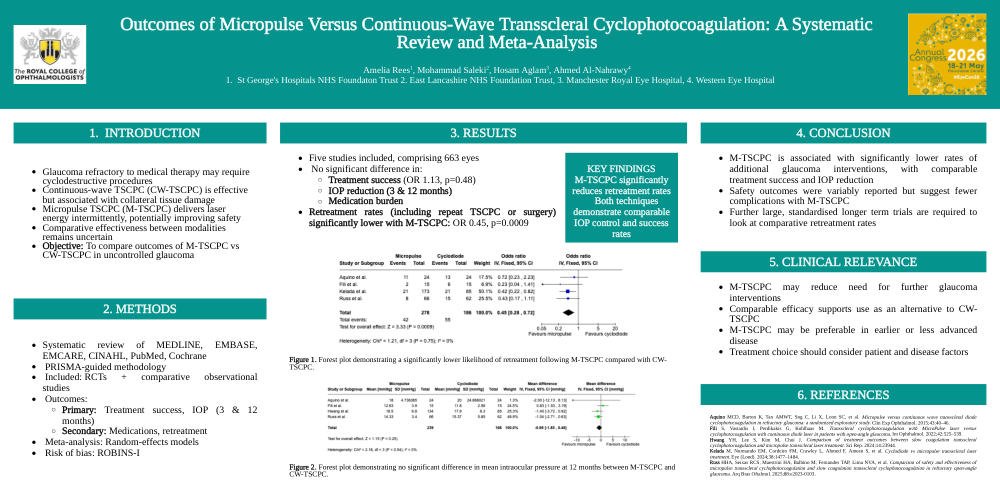
- Five studies included, comprising 663 eyes
- No significant difference in:
- Treatment success (OR 1.13, p=0.48)
- IOP reduction (3 & 12 months)
- Medication burden
- Retreatment rates (including repeat TSCPC or surgery) significantly lower with M-TSCPC: OR 0.45, p=0.0009
Figure 1. Forest plot demonstrating a significantly lower likelihood of retreatment following M-TSCPC compared with CW-TSCPC.
Figure 2. Forest plot demonstrating no significant difference in mean intraocular pressure at 12 months between M-TSCPC and CW-TSCPC.
KEY FINDINGS
M-TSCPC significantly reduces retreatment rates
Both techniques demonstrate comparable IOP control and success rates
4. CONCLUSION
- M-TSCPC is associated with significantly lower rates of additional glaucoma interventions, with comparable treatment success and IOP reduction
- Safety outcomes were variably reported but suggest fewer complications withM-TSCPC
- Further large, standardised longer term trials are required to look at comparative retreatment rates
5. CLINICAL RELEVANCE
- M-TSCPC may reduce need for further glaucoma interventions
- Comparable efficacy supports use as an alternative to CW-TSCPC
- M-TSCPC may be preferable in earlier or less advanced disease
- Treatment choice should consider patient and disease factors
6. REFERENCES
Aquino MCD, Barton K, Tan AMWT, Sng C, Li X, Loon SC, et al. Micropulse versus continuous wave transscleral diode cyclophotocoagulation in refractory glaucoma: a randomized exploratory study. Clin Exp Ophthalmol. 2015;43:40–46.
Fili S, Vastardis I, Perdikakis G, Kohlhaas M. Transscleral cyclophotocoagulation with MicroPulse laser versus cyclophotocoagulation with continuous diode laser in patients with open-angle glaucoma. Int Ophthalmol. 2022;42:525–539.
Hwang YH, Lee S, Kim M, Choi J. Comparison of treatment outcomes between slow coagulation transscleral cyclophotocoagulation and micropulse transscleral laser treatment. Sci Rep. 2024;14:23944.
Kelada M, Normando EM, Cordeiro FM, Crawley L, Ahmed F, Ameen S, et al. Cyclodiode vs micropulse transscleral laser treatment. Eye (Lond). 2024;38:1477–1484.
Russ HHA, Seixas RCS, Maestrini HA, Balbino M, Fernandes TAP, Lima NVA, et al. Comparison of safety and effectiveness of micropulse transscleral cyclophotocoagulation and slow coagulation transscleral cyclophotocoagulation in refractory open-angle glaucoma. Arq Bras Oftalmol. 2025;88:e2023-0103.