296 posters, 7 videos, 13 audios, 14 topics, 10 sessions, 1,019 authors, 259 institutions
ePostersLive by SciGen Technologies S.A. All rights reserved.
RCOphth Annual Congress 2026
18 - 21 May, 2026 | Manchester Central, Manchester

P117
NTG Evaluation of Retinal Vasculature (NERV)- Pilot data
Poster Presenter
Part of Topic
Glaucoma
NTG Evaluation of Retinal Vasculature (NERV) – PILOT DATA
Trisha Sharma 1, Wai Siene Ng 1,Emanuele Trucco 2 , Muthu Mookiah 2
1. University Hospital of Wales, Cardiff 2. University of Dundee
INTRODUCTION
Normal-tension glaucoma (NTG) is a chronic neuropathy characterized by progressive change in the optic nerve head and subsequent visual field defects. This damage results from either low or fluctuating ocular blood flow, causing ischemia and reperfusion injury at the optic nerve head, respectively.
Although ocular blood flow is often reduced because of elevated intraocular pressure (IOP), the existence of normal-tension glaucoma (NTG, with IOP < 21 mm Hg) suggests that other factors are also involved.
Vascular dysregulation is now considered a key pathogenic factor in NTG.
Greater need to evaluate retinal microcirculatory changes in glaucoma
AIMS
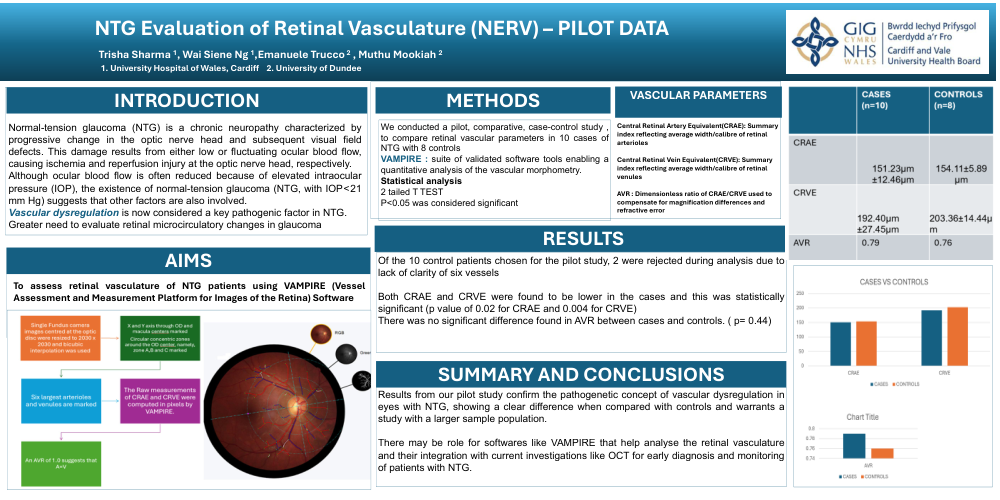
To assess retinal vasculature of NTG patients using VAMPIRE (Vessel Assessment and Measurement Platform for Images of the Retina) Software
VASCULAR PARAMETERS
Central Retinal Artery Equivalent(CRAE): Summary index reflecting average width/calibre of retinal arterioles
Central Retinal Vein Equivalent(CRVE): Summary index reflecting average width/calibre of retinal venules
AVR : Dimensionless ratio of CRAE/CRVE used to compensate for magnification differences and refractive error
METHODS
We conducted a pilot, comparative, case-control study , to compare retinal vascular parameters in 10 cases of NTG with 8 controls
VAMPIRE : suite of validated software tools enabling a quantitative analysis of the vascular morphometry.
Statistical analysis
2 tailed T TEST
P<0.05 was considered significant
RESULTS
Of the 10 control patients chosen for the pilot study, 2 were rejected during analysis due to lack of clarity of six vessels
Both CRAE and CRVE were found to be lower in the cases and this was statistically significant (p value of 0.02 for CRAE and 0.004 for CRVE)
There was no significant difference found in AVR between cases and controls. ( p= 0.44)
SUMMARY AND CONCLUSIONS
Results from our pilot study confirm the pathogenetic concept of vascular dysregulation in eyes with NTG, showing a clear difference when compared with controls and warrants a study with a larger sample population.
There may be role for softwares like VAMPIRE that help analyse the retinal vasculature and their integration with current investigations like OCT for early diagnosis and monitoring of patients with NTG.