296 posters, 7 videos, 13 audios, 14 topics, 10 sessions, 1,019 authors, 259 institutions
ePostersLive by SciGen Technologies S.A. All rights reserved.
RCOphth Annual Congress 2026
18 - 21 May, 2026 | Manchester Central, Manchester

P114
Initial UK Experience with the OCULUS Gonio-Ready Lens in Schlemm's Canal-Based and Supra-Choroidal MIGS: Enhancing Bimanual Versatility and Angle Visualisation
Poster Presenter
Part of Topic
Glaucoma
Purpose:
To evaluate the efficacy and clinical utility of the OCULUS Gonio-Ready lens in Schlemm's canal-based and Supra-Ciliary minimally invasive glaucoma surgeries (MIGS), particularly in cases requiring the use of the surgeon's second hand for globe manipulation or adjunctive instrumentation through the paracentesis.
Methods:
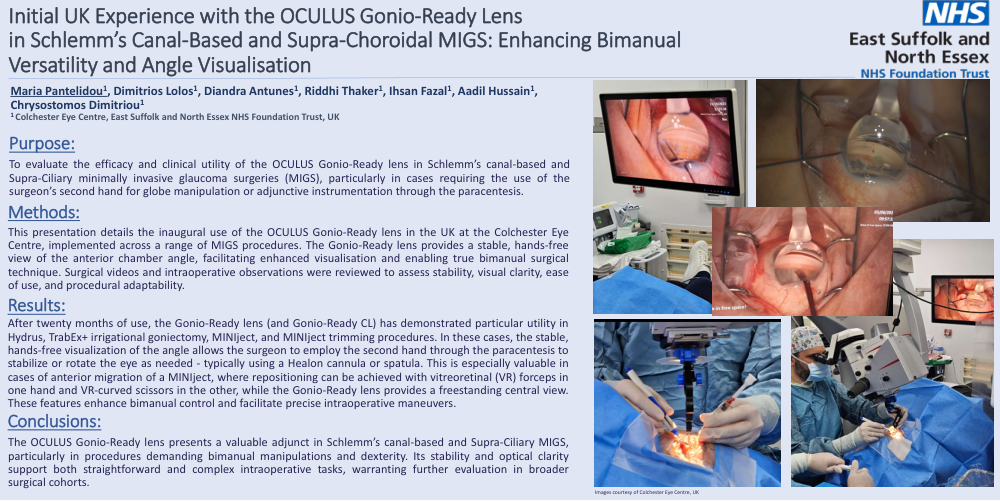
This presentation details the inaugural use of the OCULUS Gonio-Ready lens in the UK at the Colchester Eye Centre, implemented across a range of MIGS procedures. The Gonio-Ready lens provides a stable, hands-free view of the anterior chamber angle, facilitating enhanced visualisation and enabling true bimanual surgical technique. Surgical videos and intraoperative observations were reviewed to assess stability, visual clarity, ease of use, and procedural adaptability.
Results:
After twenty months of use, the Gonio-Ready lens (and Gonio-Ready CL) has demonstrated particular utility in Hydrus, TrabEx+ irrigational goniectomy, MINIject, and MINIject trimming procedures. In these cases, the stable, hands-free visualization of the angle allows the surgeon to employ the second hand through the paracentesis to stabilize or rotate the eye as needed - typically using a Healon cannula or spatula. This is especially valuable in cases of anterior migration of a MINIject, where repositioning can be achieved with vitreoretinal (VR) forceps in one hand and VR-curved scissors in the other, while the Gonio-Ready lens provides a freestanding central view. These features enhance bimanual control and facilitate precise intraoperative maneuvers.
Conclusions:
The OCULUS Gonio-Ready lens presents a valuable adjunct in Schlemm's canal-based and Supra-Ciliary MIGS, particularly in procedures demanding bimanual manipulations and dexterity. Its stability and optical clarity support both straightforward and complex intraoperative tasks, warranting further evaluation in broader surgical cohorts.