58 posters, 14 topics, 4 sessions, 188 authors, 62 institutions
ePostersLive by SciGen Technologies S.A. All rights reserved.
PSRC 69th Annual Meeting 2024
May 16-19, 2024 | The Westin Copley Place, Boston, MA

EP07
Reconstruction Distal To Ankle After Soft Tissue Sarcoma Resection
Poster Presenter
Part of Topic
Cancer
Background
The intricate anatomy of the foot, combined with the need for weightbearing and durability, makes sarcoma reconstructions distal to the ankle uniquely challenging. This study aimed to evaluate the safety and effectiveness of oncologic foot and ankle reconstruction at a quaternary oncologic referral center.
Hypothesis
Retrospective review of patients who had sarcoma reconstructions distal to the ankle between January 2016 and December 2021 at MD Anderson. Data encompassed patient demographics, tumor features, surgical specifics, and postoperative outcomes. A cross tabulation and Pearson Chi Square analysis was performed.
Methods
Retrospective review of patients who had sarcoma reconstructions distal to the ankle between January 2016 and December 2021 at MD Anderson. Data encompassed patient demographics, tumor features, surgical specifics, and postoperative outcomes. A cross tabulation and Pearson Chi Square analysis was performed.
Results
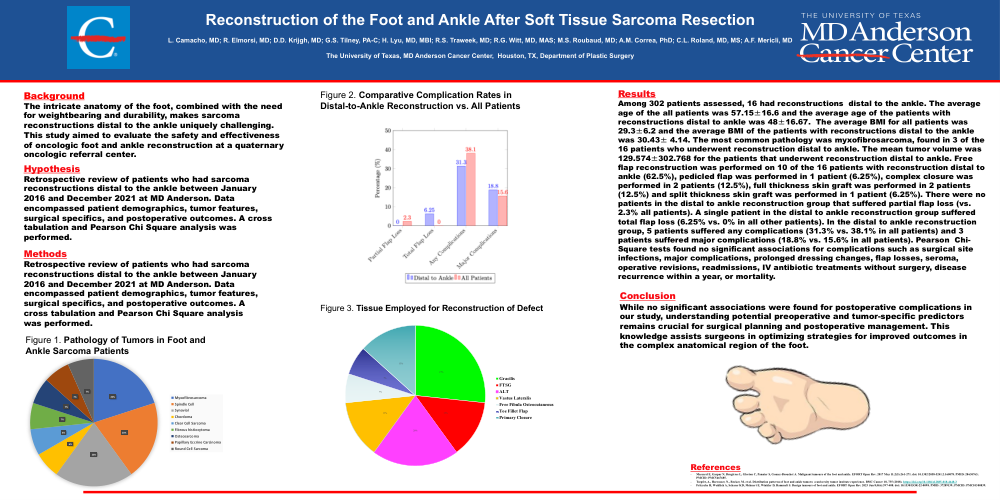
Among 302 patients assessed, 16 had reconstructions distal to the ankle. The average age of the all patients was 57.15±16.6 and the average age of the patients with reconstructions distal to ankle was 48±16.67. The average BMI for all patients was 29.3±6.2 and the average BMI of the patients with reconstructions distal to the ankle was 30.43± 4.14. The most common pathology was myxofibrosarcoma, found in 3 of the 16 patients who underwent reconstruction distal to ankle. The mean tumor volume was 129.574±302.768 for the patients that underwent reconstruction distal to ankle. Free flap reconstruction was performed on 10 of the 16 patients with reconstruction distal to ankle (62.5%), pedicled flap was performed in 1 patient (6.25%), complex closure was performed in 2 patients (12.5%), full thickness skin graft was performed in 2 patients (12.5%) and split thickness skin graft was performed in 1 patient (6.25%). There were no patients in the distal to ankle reconstruction group that suffered partial flap loss (vs. 2.3% all patients). A single patient in the distal to ankle reconstruction group suffered total flap loss (6.25% vs. 0% in all other patients). In the distal to ankle reconstruction group, 5 patients suffered any complications (31.3% vs. 38.1% in all patients) and 3 patients suffered major complications (18.8% vs. 15.6% in all patients). Pearson Chi-Square tests found no significant associations for complications such as surgical site infections, major complications, prolonged dressing changes, flap losses, seroma, operative revisions, readmissions, IV antibiotic treatments without surgery, disease recurrence within a year, or mortality.
Conclusion
While no significant associations were found for postoperative complications in our study, understanding potential preoperative and tumor-specific predictors remains crucial for surgical planning and postoperative management. This knowledge assists surgeons in optimizing strategies for improved outcomes in the complex anatomical region of the foot.