58 posters, 14 topics, 4 sessions, 188 authors, 62 institutions
ePostersLive by SciGen Technologies S.A. All rights reserved.
PSRC 69th Annual Meeting 2024
May 16-19, 2024 | The Westin Copley Place, Boston, MA

EP59
Differences Between Pediatric Burns From Rural/urban Areas And Complete/incomplete Families: Does Distance And Family Status Play A Key Role?
Part of Topic
Skin/Burn/Wound Healing
Differences Between Pediatric Burns From Rural/Urban Areas and Complete/Incomplete Families: Does Distance and Family Status Play a Key Role?
Julia Bartkova MD, MBA1, Dominika Miklisova1, Kristian Kanuscak MD2, Klaudia Jarosova MD3, Sona Hrizova4, Barbara Buganova5, assoc. prof. Pavol Janega MD, PhD4, prof. Bretislav Lipovy, MD, PhD, MBA, LLM, FICS1, prof. Paul S. Cederna MD, FACS6
1. Department of Burns and Plastic Surgery, Institution Shared with the University Hospital Brno, Faculty of Medicine, Masaryk University, Czech Republic
2. Department of Surgery, Hospital Kyjov, Czech Republic
3. Department of Urology, St. Anne´s University Hospital Brno, Brno, Czech Republic
4. Faculty of Medicine, Comenius University Bratislava, Slovakia
5. Faculty of Medicine of the Slovak Medical University, Bratislava, Slovakia
6. Department of Surgery, Section of Plastic Surgery, University of Michigan Health System, Ann Arbor, Michigan
PURPOSE: There are many important factors that impact the outcomes following pediatric burn injuries. Several epidemiologic factors impact the types of burns pediatric patients expereince. There are also several factors that impact the care they receive. The purpose of this study was to evaluate the epidemiological characteristics and access to care of pediatric burns patients admitted to a single burn unit in the Czech Republic. In particular, our goal was to assess whether differenes exist between the severity and treatment of children who sustain burns in rural or urban areas and the presence of a complete or incomplete family.
METHODS : A retrospective analysis was conducted from the January 2005 to December, 2022. Patients under the age of 18 years, who were hospitalized in the single Burn Unit, were included in the study.
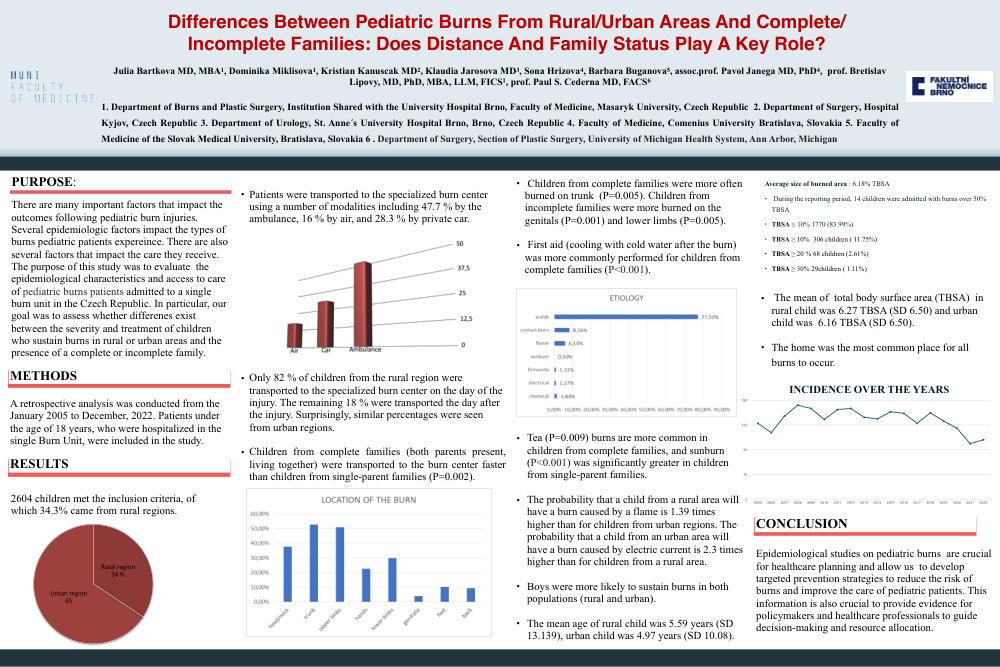
RESULTS : 2604 children met the inclusion criteria, of which 34.3% came from rural regions. Patients were transported to the specialized burn center using a number of modalities including 47.7 % by the ambulance, 16 % by air, and 28.3 % by private car. Only 82 % of children from the rural region were transported to the specialized burn center on the day of the injury. The remaining 18 % were transported the day after the injury. Surprisingly, similar percentages were seen from urban regions. Children from complete families (both parents present, living together) were transported to the burn center faster than children from single-parent families (P=0.002). First aid (cooling with cold water after the burn) was more commonly performed for children from complete families (P<0.001). Children from complete families were more often burned on trunk (P=0.005). Children from incomplete families were more burned on the genitals (P=0.001) and lower limbs (P=0.005). The need for admission to an intensive care unit was similar for patients from rural and urban regions. Tea (P=0.009) burns are more common in children from complete families, and sunburn (P<0.001) was significantly greater in children from single-parent families. The probability that a child from a rural area will have a burn caused by a flame is 1.39 times higher than for children from urban regions. The probability that a child from an urban area will have a burn caused by electric current is 2.3 times higher than for children from a rural area. Boys were more likely to sustain burns in both populations (rural and urban). The mean age of rural child was 5.59 years (SD 13.139), urban child was 4.97 years (SD 10.08). The mean of total body surface area (TBSA) in rural child was 6.27 TBSA (SD 6.50) and urban child was 6.16 TBSA (SD 6.50). The home was the most common place for all burns to occur.
CONCLUSIONS : Epidemiological studies on pediatric burns are crucial for healthcare planning and allow us to develop targeted prevention strategies to reduce the risk of burns and improve the care of pediatric patients. This information is also crucial to provide evidence for policymakers and healthcare professionals to guide decision-making and resource allocation.