58 posters, 14 topics, 4 sessions, 188 authors, 62 institutions
ePostersLive by SciGen Technologies S.A. All rights reserved.
PSRC 69th Annual Meeting 2024
May 16-19, 2024 | The Westin Copley Place, Boston, MA

EP31
Comparative Analysis Of Revision Peritoneal Flap And Intestinal Segment Vaginoplasty In Transgender Females
Poster Presenter
Authors
Christian Lava, Lauren Berger, Karen Li, Rachel Rohrich, Ilana Margulies, Anusha Singh, Banafsheh Sharif-Askary, Kenneth Fan, David Lisle, Gabriel Del Corral
Affiliations
Rutgers New Jersey Medical School, Department of Plastic and Reconstructive Surgery, MedStar Georgetown University Hospital, Georgetown University School of Medicine, Department of Plastic and Reconstructive Surgery, MedStar Franklin Square Medical Center
Part of Topic
Gender Affirmation Medicine/Surgery
A Comparative Analysis of Peritoneal Flap and Intestinal Vaginoplasty for Management of Vaginal Stenosis
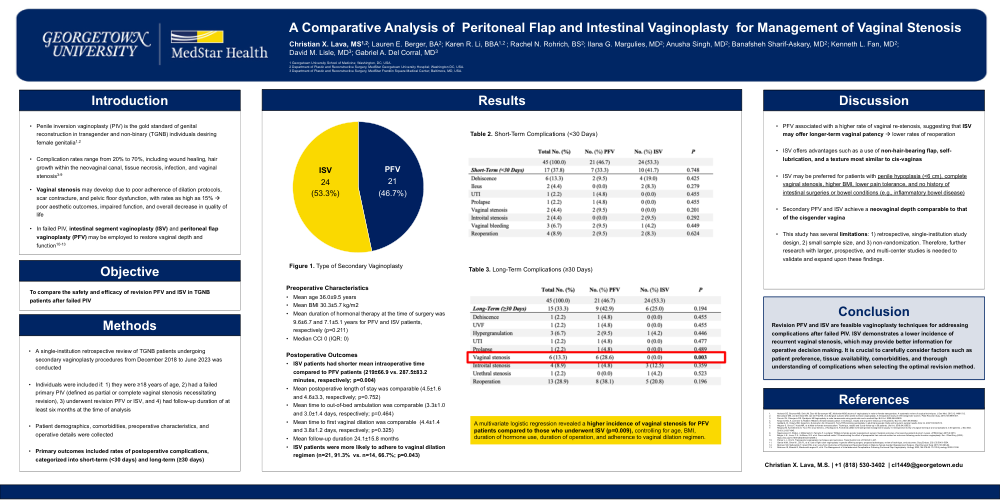
Background: Penile inversion vaginoplasty (PIV) is widely recognized as the preeminent method for gender-affirming genital reconstruction in transgender and non-binary (TGNB) patients. However, in cases of failed PIV, peritoneal flap vaginoplasty (PFV) and intestinal segment vaginoplasty (ISV) facilitate restoration of neovaginal depth and sexual function. The objective of this study is to compare the safety and efficacy profiles of revision PFV and ISV in TGNB patients with failed PIV.
Methods: A single-center retrospective review of all TGNB patients undergoing secondary PFV or ISV from December 2018 to April 2023 was conducted. Perioperative and outcomes data were collected and compared between groups.
Results: Twenty-one (5.8%) patients underwent secondary PFV and 24 (6.6%) underwent secondary ISV. All cases were due to vaginal stenosis (n=45, 100.0%). ISV had a shorter mean intraoperative time (219±66.9 vs. 287.5±83.2 minutes, p=0.004). There were no significant differences between groups in mean duration to first successful dilation or average vaginal depth. Mean follow-up was 24.1±15.8 months. Seven (33.3%) PFV patients experienced short-term complications, including introital dehiscence (n=2, 9.5%), vaginal stenosis (n=2, 9.5%), vaginal bleeding (n=2, 9.5%), and reoperation (n=2, 9.5%). Nine (42.9%) experienced long-term complications, including urethrovaginal fistula formation (n=2, 9.5%), hypergranulation (n=2, 9.5%), vaginal stenosis (n=7, 33.3%), and reoperation (n=6, 28.6%). Ten (41.7%) ISV patients experienced short-term complications, including dehiscence (n=4, 19.0%), ileus (n=2, 8.3%), introital stenosis (n=2, 9.5%), and reoperation due to vaginal bleeding (n=2, 8.3%). Six (25.0%) experienced long-term complications, including introital stenosis (n=3, 12.5%), mucosal prolapse (n=2, 8.3%), and reoperation due to mucosal prolapse (n=4, 16.7%). Secondary PFV had a higher rate of vaginal stenosis (p=0.003). Collectively, there were no cases of partial or full-thickness flap necrosis.
Conclusion: Both revision PFV and ISV represent viable techniques for addressing vaginal stenosis secondary to PIV. While PFV and ISV have comparable rates of short-term complications, ISV demonstrates a lower incidence of recurrent vaginal stenosis, which may better inform operative decision-making.