Loading...

358 posters, 97 topics, 122 sessions, 958 authors, 239 institutions

ePostersLive by SciGen Technologies S.A. All rights reserved.

79th PostGraduate Assembly in Anesthesiology 2025

December 12 - 15, 2025 | New York City

79th PostGraduate Assembly in Anesthesiology 2025 banner

2097

Threading the Needle: Sedated Nasal Fiberoptic Intubation in a Geriatric Patient With Trismus and Deep Neck Abscess
Part of Topic

Airway - Geriatric

Threading the Needle: Sedated Nasal Fiberoptic Intubation in a Geriatric Patient With Trismus and Deep Neck Abscess

Michael Lu, BA 1; Madison Garrity, DDS 2; Sophia Jacob, MD 2; Stephen DiMaria, MD 2; Eman Nada, MBBCh, PhD 2

Renaissance School of Medicine, Stony Brook University 1 Department of Anesthesiology, Stony Brook Medicine 2


Introduction

Learning Objective

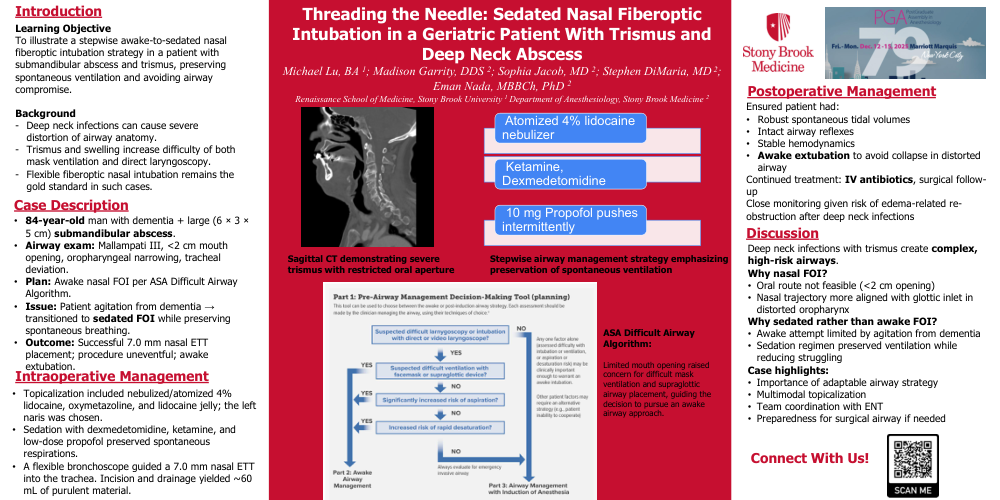
To illustrate a stepwise awake-to-sedated nasal fiberoptic intubation strategy in a patient with submandibular abscess and trismus, preserving spontaneous ventilation and avoiding airway compromise.


Background

-Deep neck infections can cause severe distortion of airway anatomy.
-Trismus and swelling increase difficulty of both mask ventilation and direct laryngoscopy.
-Flexible fiberoptic nasal intubation remains the gold standard in such cases.
 

Case Description

•84-year-old man with dementia + large (6 × 3 × 5 cm) submandibular abscess.
•Airway exam: Mallampati III, <2 cm mouth opening, oropharyngeal narrowing, tracheal deviation.
•Plan: Awake nasal FOI per ASA Difficult Airway Algorithm.
•Issue: Patient agitation from dementia → transitioned to sedated FOI while preserving spontaneous breathing.
•Outcome: Successful 7.0 mm nasal ETT placement; procedure uneventful; awake extubation.
 

Intraoperative Management

•Topicalization included nebulized/atomized 4% lidocaine, oxymetazoline, and lidocaine jelly; the left naris was chosen.
•Sedation with dexmedetomidine, ketamine, and low-dose propofol preserved spontaneous respirations.
•A flexible bronchoscope guided a 7.0 mm nasal ETT into the trachea. Incision and drainage yielded ~60 mL of purulent material.
 

Postoperative Management

Ensured patient had:

•Robust spontaneous tidal volumes
•Intact airway reflexes
•Stable hemodynamics
•Awake extubation to avoid collapse in distorted airway

Continued treatment: IV antibiotics, surgical follow-up

Close monitoring given risk of edema-related re-obstruction after deep neck infections


Discussion

Deep neck infections with trismus create complex, high-risk airways.

Why nasal FOI?

•Oral route not feasible (<2 cm opening)
•Nasal trajectory more aligned with glottic inlet in distorted oropharynx

Why sedated rather than awake FOI?

•Awake attempt limited by agitation from dementia
•Sedation regimen preserved ventilation while reducing struggling

Case highlights:

•Importance of adaptable airway strategy
•Multimodal topicalization
•Team coordination with ENT
•Preparedness for surgical airway if needed


pga2025 banner
Copyright © 2015-2026, ePostersLive® SciGen is a registered trademark of SciGen Technologies S.A. Patent pending.

This website and third-party tools we use rely on cookies for the best user experience. By selecting "I agree", you agree to cookie usage as described in our Privacy Policy.