358 posters, 97 topics, 122 sessions, 958 authors, 239 institutions
ePostersLive by SciGen Technologies S.A. All rights reserved.
79th PostGraduate Assembly in Anesthesiology 2025
December 12 - 15, 2025 | New York City

2048
Sounding the Alarm: Anesthetic Recognition of Coronary Sinus Perforation in the Electrophysiology (EP) Lab
Poster Presenter
Authors
Affiliations
Part of Topic
Cardiovascular
CASE DESCRIPTION
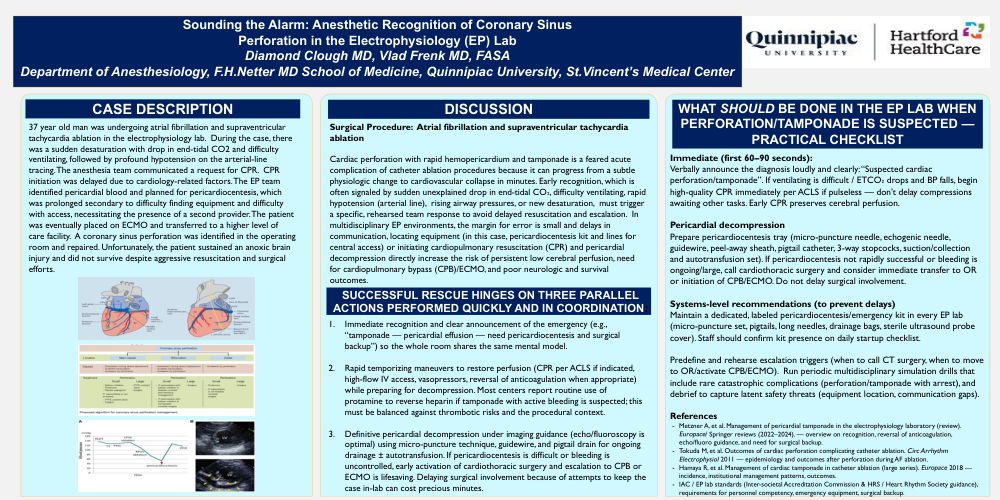
37 year old man was undergoing atrial fibrillation and supraventricular tachycardia ablation in the electrophysiology lab. During the case, there was a sudden desaturation with drop in end-tidal CO2 and difficulty ventilating, followed by profound hypotension on the arterial-line tracing. The anesthesia team communicated a request for CPR. CPR initiation was delayed due to cardiology-related factors. The EP team identified pericardial blood and planned for pericardiocentesis, which was prolonged secondary to difficulty finding equipment and difficulty with access, necessitating the presence of a second provider. The patient was eventually placed on ECMO and transferred to a higher level of care facility. A coronary sinus perforation was identified in the operating room and repaired. Unfortunately, the patient sustained an anoxic brain injury and did not survive despite aggressive resuscitation and surgical efforts.'
DISCUSSION
Surgical Procedure: Atrial fibrillation and supraventricular tachycardia ablation
Cardiac perforation with rapid hemopericardium and tamponade is a feared acute complication of catheter ablation procedures because it can progress from a subtle physiologic change to cardiovascular collapse in minutes. Early recognition, which is often signaled by sudden unexplained drop in end-tidal CO₂, difficulty ventilating, rapid hypotension (arterial line), rising airway pressures, or new desaturation, must trigger a specific, rehearsed team response to avoid delayed resuscitation and escalation. In multidisciplinary EP environments, the margin for error is small and delays in communication, locating equipment (in this case, pericardiocentesis kit and lines for central access) or initiating cardiopulmonary resuscitation (CPR) and pericardial decompression directly increase the risk of persistent low cerebral perfusion, need for cardiopulmonary bypass (CPB)/ECMO, and poor neurologic and survival outcomes.
SUCCESSFUL RESCUE HINGES ON THREE PARALLEL ACTIONS PERFORMED QUICKLY AND IN COORDINATION
WHAT SHOULD BE DONE IN THE EP LAB WHEN PERFORATION/TAMPONADE IS SUSPECTED — PRACTICAL CHECKLIST
Immediate (first 60–90 seconds):
Verbally announce the diagnosis loudly and clearly: “Suspected cardiac perforation/tamponade”. If ventilating is difficult / ETCO₂ drops and BP falls, begin high-quality CPR immediately per ACLS if pulseless — don’t delay compressions awaiting other tasks. Early CPR preserves cerebral perfusion.
Pericardial decompression
Prepare pericardiocentesis tray (micro-puncture needle, echogenic needle, guidewire, peel-away sheath, pigtail catheter, 3-way stopcocks, suction/collection and autotransfusion set). If pericardiocentesis not rapidly successful or bleeding is ongoing/large, call cardiothoracic surgery and consider immediate transfer to OR or initiation of CPB/ECMO. Do not delay surgical involvement.
Systems-level recommendations (to prevent delays)
Maintain a dedicated, labeled pericardiocentesis/emergency kit in every EP lab (micro-puncture set, pigtails, long needles, drainage bags, sterile ultrasound probe cover). Staff should confirm kit presence on daily startup checklist.
Predefine and rehearse escalation triggers (when to call CT surgery, when to move to OR/activate CPB/ECMO). Run periodic multidisciplinary simulation drills that include rare catastrophic complications (perforation/tamponade with arrest), and debrief to capture latent safety threats (equipment location, communication gaps).
References:
- Metzner A, et al. Management of pericardial tamponade in the electrophysiology laboratory (review). Europace / Springer reviews (2022–2024). — overview on recognition, reversal of anticoagulation, echo/fluoro guidance, and need for surgical backup. - Tokuda M, et al. Outcomes of cardiac perforation complicating catheter ablation. Circ Arrhythm Electrophysiol 2011 — epidemiology and outcomes after perforation during AF ablation.
- Hamaya R, et al. Management of cardiac tamponade in catheter ablation (large series). Europace 2018 — incidence, institutional management patterns, outcomes.
- IAC / EP lab standards (Inter-societal Accreditation Commission & HRS / Heart Rhythm Society guidance), requirements for personnel competency, emergency equipment, surgical backup.