358 posters, 97 topics, 122 sessions, 958 authors, 239 institutions
ePostersLive by SciGen Technologies S.A. All rights reserved.
79th PostGraduate Assembly in Anesthesiology 2025
December 12 - 15, 2025 | New York City

4017
Medication Inventory Optimization & Environmental Impact: Anesthesiology’s Perspective
Part of Topic
Perioperative Management - OTHER Quality Improvement
•Healthcare costs result from a complex combination of expense, waste and medication errors
•We must reassess healthcare at multiple levels to limit expenses
•One significant source of waste is unused medications left to expire, which has negative impacts on the environment and poses a threat to patient safety
•To address this, we audited perioperative medication inventory for department-specific utilization rates
•33 automated medication dispensing cabinets (AMDCs) across 5 departments were evaluated over 28 weeks for stock and usage to determine department-specific demand
•Parameters monitored:
•Total medication used
•Maximum amount used in one day
•Average daily use
•Number of days the medication ran out of stock
•Interprofessional collaboration with the Pharmacy department determined:
•Per unit cost of medications
•Calculated annual expenditure
•Identified areas for stock adjustment
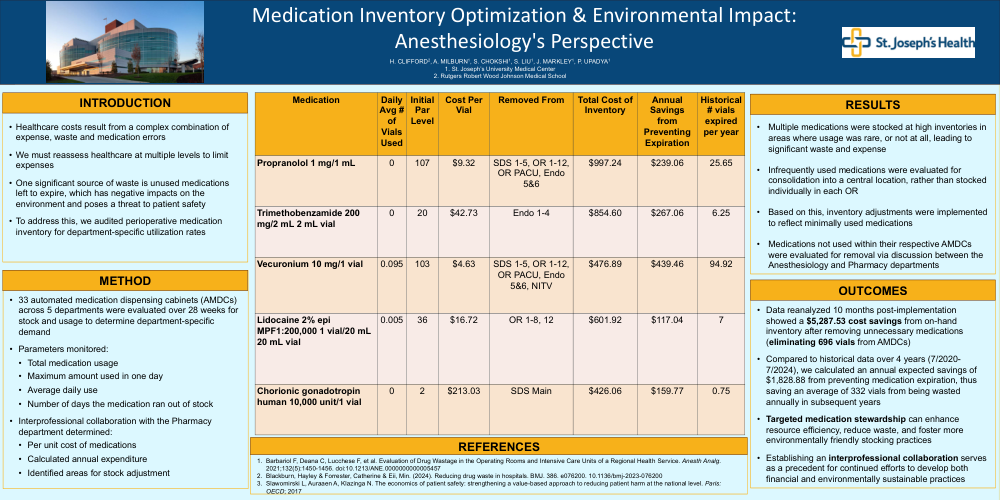
•Multiple medications were stocked at high inventories in areas where usage was rare, or not at all, leading to significant waste and expense
•Infrequently used medications were evaluated for consolidation into a central location, rather than stocked individually in each OR
•Inventory adjustments were implemented to reflect minimally used medications
•Medications not used within their respective AMDCs were evaluated for removal via discussion between the Anesthesiology and Pharmacy departments
•Data reanalyzed 10 months post-implementation showed a $5,287.53 cost savings from on-hand inventory after removing unnecessary medications (eliminating 696 vials from AMDCs)
•Compared to historical data over 4 years (7/2020-7/2024), we calculated an annual expected savings of $1,828.88 from preventing medication expiration, thus saving an average of 332 vials from being wasted annually in subsequent years
•Targeted medication stewardship can enhance resource efficiency, reduce waste, and foster more environmentally friendly stocking practices
•Establishing interprofessional collaboration serves as a precedent to develop both financial and environmentally sustainable practices
1.Barbariol F, Deana C, Lucchese F, et al. Evaluation of Drug Wastage in the Operating Rooms and Intensive Care Units of a Regional Health Service. Anesth Analg. 2021;132(5):1450-1456. doi:10.1213/ANE.0000000000005457
2.Blackburn, Hayley & Forrester, Catherine & Eii, Min. (2024). Reducing drug waste in hospitals. BMJ. 386. e076200. 10.1136/bmj-2023-076200
3.Slawomirski L, Auraaen A, Klazinga N. The economics of patient safety: strengthening a value-based approach to reducing patient harm at the national level. Paris: OECD; 2017