358 posters, 97 topics, 122 sessions, 958 authors, 239 institutions
ePostersLive by SciGen Technologies S.A. All rights reserved.
79th PostGraduate Assembly in Anesthesiology 2025
December 12 - 15, 2025 | New York City

4010
Pilot Implementation of Programmed Intermittent Epidural Bolus as the Background Infusion for Parturient-Controlled Epidural Analgesia in a Newark Laboring Population
Poster Presenter
Part of Topic
Obstetrics - OTHER Quality Improvement
Translating Evidence to Practice:
Pilot Implementation of Intermittent Bolus Epidural Technique in a Newark Laboring Population
A SYSTEMS BASED PRACTICE PROJECT
Introduction
•Epidural analgesia is the gold standard for labor pain management, providing effective and controllable anesthesia during labor.
•Recent meta-analyses have suggested superiority with intermittent bolus compared to continuous infusion regarding maternal pain relief, labor progression, and neonatal outcomes. [1]
Objectives
1.To compare the efficacy of intermittent bolus versus continuous infusion epidural techniques in managing labor pain, medication usage, and labor duration (Stages 1, 2, and 3) in laboring patients in the Newark, NJ population
2.To conduct a systems-based practice project to improve quality of care by evaluating the impact of epidural analgesia delivery method on outcomes in our population
Methods
1.Retrospective and prospective cohort study conducted at University Hospital (UH) during two periods:
•March–April 2024 (continuous infusion + PCEA)
•January–May 2025 (intermittent bolus + PCEA)
2.A protocol detailing benefits of intermittent bolus versus continuous epidural infusion was created and implementation of intermittent boluses was explained to the OB Anesthesia resident and attending physician.
3.Data Collection:
•Patients with vaginal deliveries who had epidurals were identified during theses time periods.
•Exclusions: CSE, fetal demise, conversion to C-Section, epidural replaced
4.Pre- and post- intervention data was extracted from EMR and recorded in a protected spreadsheet including VAS pain scores at pre- (0 hr) and multiple post-epidural time points (1,6,12,24 hr), medication usage including infusion rates and volumes, narcotic usage, additional manual boluses, labor durations for stages 1, 2, & 3, and neonatal Apgar scores.
5.Data analysis was performed using SPSS (T-Test and Effect Size analysis).
Results
•130 laboring patients were identified pre-intervention and 42 post-intervention.
•The mean age of the population in both groups was 27 years old.
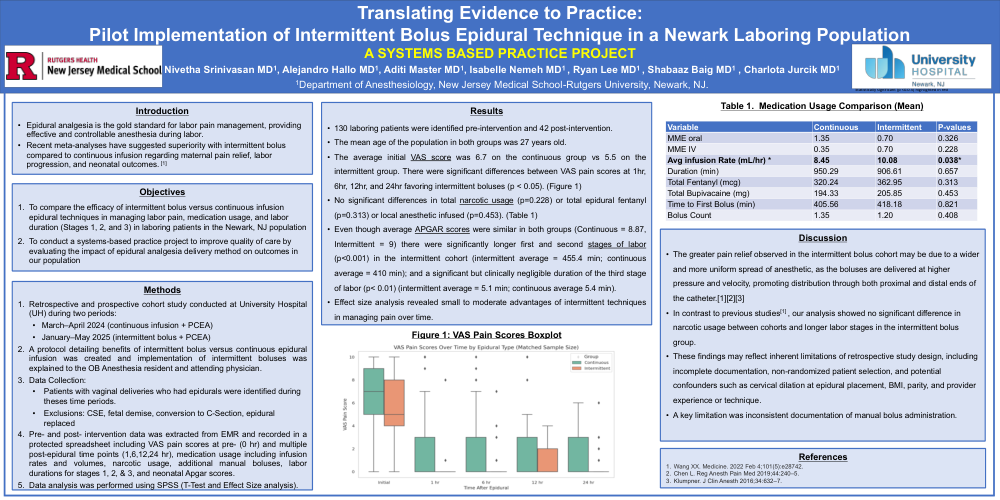
•The average initial VAS score was 6.7 on the continuous group vs 5.5 on the intermittent group. There were significant differences between VAS pain scores at 1hr, 6hr, 12hr, and 24hr favoring intermittent boluses (p < 0.05). (Figure 1)
•No significant differences in total narcotic usage (p=0.228) or total epidural fentanyl (p=0.313) or local anesthetic infused (p=0.453). (Table 1)
•Even though average APGAR scores were similar in both groups (Continuous = 8.87, Intermittent = 9) there were significantly longer first and second stages of labor (p<0.001) in the intermittent cohort (intermittent average = 455.4 min; continuous average = 410 min); and a significant but clinically negligible duration of the third stage of labor (p< 0.01) (intermittent average = 5.1 min; continuous average 5.4 min).
•Effect size analysis revealed small to moderate advantages of intermittent techniques in managing pain over time.
Discussion
•The greater pain relief observed in the intermittent bolus cohort may be due to a wider and more uniform spread of anesthetic, as the boluses are delivered at higher pressure and velocity, promoting distribution through both proximal and distal ends of the catheter.[1][2][3]
•In contrast to previous studies[1] , our analysis showed no significant difference in narcotic usage between cohorts and longer labor stages in the intermittent bolus group.
•These findings may reflect inherent limitations of retrospective study design, including incomplete documentation, non-randomized patient selection, and potential confounders such as cervical dilation at epidural placement, BMI, parity, and provider experience or technique.
•A key limitation was inconsistent documentation of manual bolus administration.