358 posters, 97 topics, 122 sessions, 958 authors, 239 institutions
ePostersLive by SciGen Technologies S.A. All rights reserved.
79th PostGraduate Assembly in Anesthesiology 2025
December 12 - 15, 2025 | New York City

3135
The Role of Transversus Abdominis Plane Blocks in Post-Cesarean Analgesia: Exploring Links Between Maternal Pain Management, Childbirth Satisfaction, and Postpartum Depression
Part of Topic
Cardiovascular
Purpose
We evaluated whether transversus abdominis plane (TAP) blocks improve maternal satisfaction compared to other analgesic techniques in cesarean delivery. TAP blocks may offer benefits for maternal satisfaction over placebo or no block, but their effectiveness relative to other analgesic methods remains unclear. While appropriate analgesia may influence maternal satisfaction and potentially postpartum depression, research on this connection is limited. Further studies are needed to clarify how different analgesic approaches impact both short- and long-term maternal outcomes.
Introduction
Postpartum depression can affect up to 20% of postpartum patients¹. One study found that lower patient satisfaction with childbirth can increase the risk of postpartum depression². While transversus abdominis plane (TAP) blocks are commonly used for post-cesarean analgesia, their impact on maternal satisfaction—an important contributor to postpartum mental health—remains understudied relative to other analgesic modalities³. Previous reviews have yet to examine the influence of TAP blocks on maternal satisfaction scores in comparison to multiple other analgesia techniques. We aim to evaluate whether TAP blocks are associated with improved maternal satisfaction in comparison to other analgesic techniques post-cesarean delivery.
Methods
A literature review was conducted on the PubMed database, published in the year 2010 onward, with the terms ‘transversus abdominis plane block’ AND ‘cesarean’. Randomized controlled trials that compared maternal satisfaction in patients who received TAP blocks to other postoperative cesarean analgesia modalities were included. Non-English and non-human studies were excluded. Forty-seven papers were reviewed.
Results
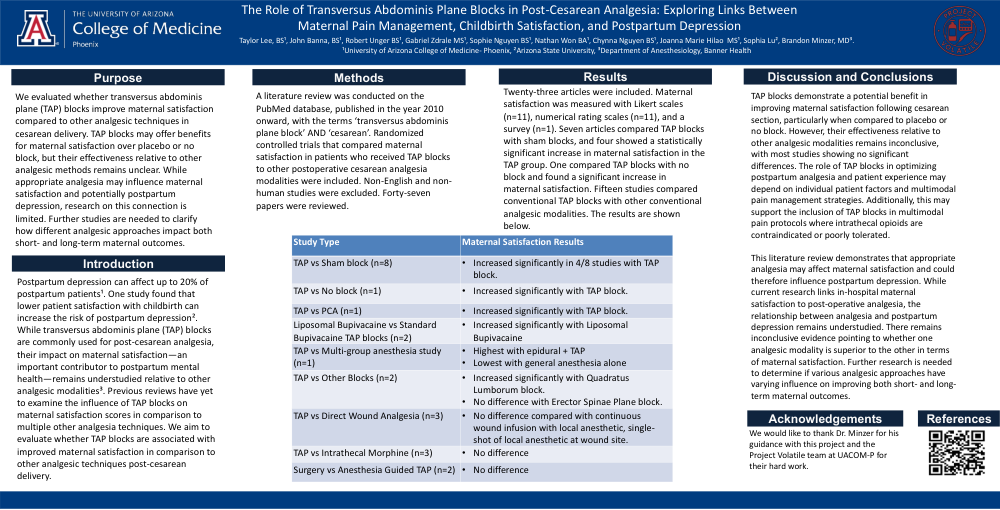
Twenty-three articles were included. Maternal satisfaction was measured with Likert scales (n=11), numerical rating scales (n=11), and a survey (n=1). Seven articles compared TAP blocks with sham blocks, and four showed a statistically significant increase in maternal satisfaction in the TAP group. One compared TAP blocks with no block and found a significant increase in maternal satisfaction. Fifteen studies compared conventional TAP blocks with other conventional analgesic modalities. The results are shown below.
Discussion and Conclusions
TAP blocks demonstrate a potential benefit in improving maternal satisfaction following cesarean section, particularly when compared to placebo or no block. However, their effectiveness relative to other analgesic modalities remains inconclusive, with most studies showing no significant differences. The role of TAP blocks in optimizing postpartum analgesia and patient experience may depend on individual patient factors and multimodal pain management strategies. Additionally, this may support the inclusion of TAP blocks in multimodal pain protocols where intrathecal opioids are contraindicated or poorly tolerated.
This literature review demonstrates that appropriate analgesia may affect maternal satisfaction and could therefore influence postpartum depression. While current research links in-hospital maternal satisfaction to post-operative analgesia, the relationship between analgesia and postpartum depression remains understudied. There remains inconclusive evidence pointing to whether one analgesic modality is superior to the other in terms of maternal satisfaction. Further research is needed to determine if various analgesic approaches have varying influence on improving both short- and long-term maternal outcomes.