358 posters, 97 topics, 122 sessions, 958 authors, 239 institutions
ePostersLive by SciGen Technologies S.A. All rights reserved.
79th PostGraduate Assembly in Anesthesiology 2025
December 12 - 15, 2025 | New York City

3112
Hemodynamic Stability and Rapid Recovery with Remimazolam versus Propofol in Bronchoscopy: A Single-Center Retrospective Cohort Study
Poster Presenter
Authors
Affiliations
Part of Topic
Critical Care - Obstetrics
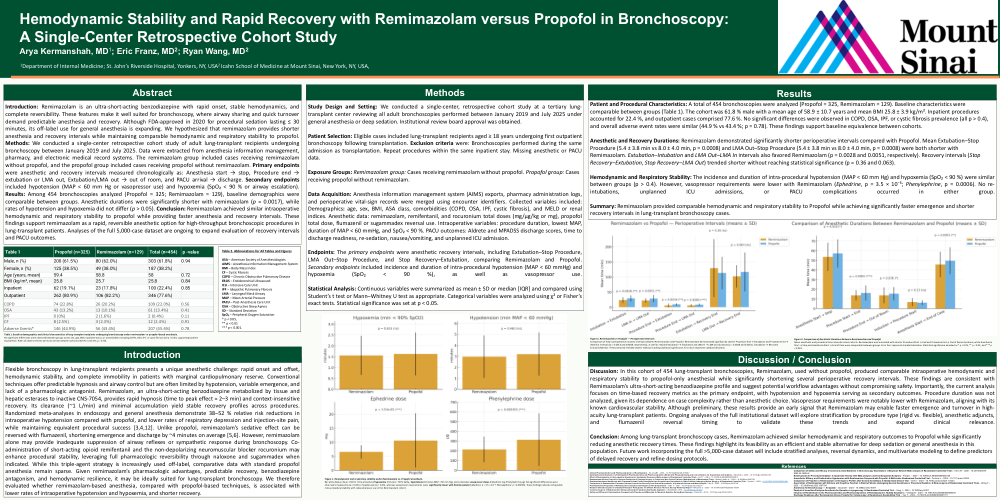
Introduction: Remimazolam is an ultra-short-acting benzodiazepine with rapid onset, stable hemodynamics, and complete reversibility. These features make it well suited for bronchoscopy, where airway sharing and quick turnover demand predictable anesthesia and recovery. Although FDA-approved in 2020 for procedural sedation lasting ≤ 30 minutes, its off-label use for general anesthesia is expanding. We hypothesized that remimazolam provides shorter anesthesia and recovery intervals while maintaining comparable hemodynamic and respiratory stability to propofol. Methods: We conducted a single-center retrospective cohort study of adult lung-transplant recipients undergoing bronchoscopy between January 2019 and July 2025. Data were extracted from anesthesia information management, pharmacy, and electronic medical record systems. The remimazolam group included cases receiving remimazolam without propofol, and the propofol group included cases receiving propofol without remimazolam. Primary endpoints were anesthetic and recovery intervals measured chronologically as: Anesthesia start → stop, Procedure end → extubation or LMA out, Extubation/LMA out → out of room, and PACU arrival → discharge. Secondary endpoints included hypotension (MAP < 60 mm Hg or vasopressor use) and hypoxemia (SpO₂ < 90 % or airway escalation). Results: Among 454 bronchoscopies analyzed (Propofol = 325; Remimazolam = 129), baseline demographics were comparable between groups. Anesthetic durations were significantly shorter with remimazolam (p = 0.0017), while rates of hypotension and hypoxemia did not differ (p > 0.05). Conclusion: Remimazolam achieved similar intraoperative hemodynamic and respiratory stability to propofol while providing faster anesthesia and recovery intervals. These findings support remimazolam as a rapid, reversible anesthetic option for high-throughput bronchoscopic procedures in lung-transplant patients. Analyses of the full 5,000-case dataset are ongoing to expand evaluation of recovery intervals and PACU outcomes. Statistical significance denoted as * p < 0.05, ** p < 0.01, and *** p < 0.001.
Intro
Flexible bronchoscopy in lung-transplant recipients presents a unique anesthetic challenge: rapid onset and offset, hemodynamic stability, and complete immobility in patients with marginal cardiopulmonary reserve. Conventional techniques offer predictable hypnosis and airway control but are often limited by hypotension, variable emergence, and lack of a pharmacologic antagonist. Remimazolam, an ultra-short-acting benzodiazepine metabolized by tissue and hepatic esterases to inactive CNS-7054, provides rapid hypnosis (time to peak effect ≈ 2–3 min) and context-insensitive recovery. Its clearance (~1 L/min) and minimal accumulation yield stable recovery profiles across procedures. Randomized meta-analyses in endoscopy and general anesthesia demonstrate 38–52 % relative risk reductions in intraoperative hypotension compared with propofol, and lower rates of respiratory depression and injection-site pain, while maintaining equivalent procedural success [3,4,12]. Unlike propofol, remimazolam’s sedative effect can be reversed with flumazenil, shortening emergence and discharge by ~4 minutes on average [5,6]. However, remimazolam alone may provide inadequate suppression of airway reflexes or sympathetic response during bronchoscopy. Co-administration of short-acting opioid remifentanil and the non-depolarizing neuromuscular blocker rocuronium may enhance procedural stability, leveraging full pharmacologic reversibility through naloxone and sugammadex when indicated. While this triple-agent strategy is increasingly used off-label, comparative data with standard propofol anesthesia remain sparse. Given remimazolam’s pharmacologic advantages, predictable recovery, benzodiazepine antagonism, and hemodynamic resilience, it may be ideally suited for lung-transplant bronchoscopy. We therefore evaluated whether remimazolam-based anesthesia, compared with propofol-based techniques, is associated with lower rates of intraoperative hypotension and hypoxemia, and shorter recovery.
Methods
Study Design and Setting: We conducted a single-center, retrospective cohort study at a tertiary lung-transplant center reviewing all adult bronchoscopies performed between January 2019 and July 2025 under general anesthesia or deep sedation. Institutional review board approval was obtained.
Patient Selection: Eligible cases included lung-transplant recipients aged ≥ 18 years undergoing first outpatient bronchoscopy following transplantation. Exclusion criteria were: Bronchoscopies performed during the same admission as transplantation. Repeat procedures within the same inpatient stay. Missing anesthetic or PACU data.
Exposure Groups: Remimazolam group: Cases receiving remimazolam without propofol. Propofolgroup: Cases receiving propofol without remimazolam.
Data Acquisition: Anesthesia information management system (AIMS) exports, pharmacy administration logs, and perioperative vital-sign records were merged using encounter identifiers. Collected variables included: Demographics: age, sex, BMI, ASA class, comorbidities (COPD, OSA, IPF, cystic fibrosis), and MELD or renal indices. Anesthetic data: remimazolam, remifentanil, and rocuronium total doses (mg/µg/kg or mg), propofol total dose, flumazenil or sugammadex reversal use. Intraoperative variables: procedure duration, lowest MAP, duration of MAP < 60 mmHg, and SpO₂ < 90 %. PACU outcomes: Aldrete and MPADSS discharge scores, time to discharge readiness, re-sedation, nausea/vomiting, and unplanned ICU admission.
Endpoints: The primary endpoints were anesthetic recovery intervals, including Extubation–Stop Procedure, LMA Out–Stop Procedure, and Stop Recovery–Extubation, comparing Remimazolam and Propofol.
Secondary endpoints included incidence and duration of intra-procedural hypotension (MAP < 60 mmHg) and hypoxemia (SpO₂ < 90 %), as well as vasopressor use.
Statistical Analysis: Continuous variables were summarized as mean ± SD or median [IQR] and compared using Student’s t test or Mann–Whitney U test as appropriate. Categorical variables were analyzed using χ² or Fisher’s exact tests. Statistical significance was set at p < 0.05.
Results:
Patient and Procedural Characteristics: A total of 454 bronchoscopies were analyzed (Propofol = 325, Remimazolam = 129). Baseline characteristics were comparable between groups (Table 1). The cohort was 61.8 % male with a mean age of 58.9 ± 10.7 years and mean BMI 25.8 ± 3.9 kg/m². Inpatient procedures accounted for 22.4 %, and outpatient cases comprised 77.6 %. No significant differences were observed in COPD, OSA, IPF, or cystic fibrosis prevalence (all p > 0.4), and overall adverse event rates were similar (44.9 % vs 43.4 %; p = 0.78). These findings support baseline equivalence between cohorts.
Anesthetic and Recovery Durations: Remimazolamdemonstrated significantly shorter perioperative intervals compared with Propofol. Mean Extubation–Stop Procedure (5.4 ± 3.8 min vs 8.0 ± 4.0 min, p = 0.0008) and LMA Out–Stop Procedure (5.4 ± 3.8 min vs 8.0 ± 4.0 min, p = 0.0008) were both shorter with Remimazolam. Extubation–Intubation and LMA Out–LMA In intervals also favored Remimazolam (p = 0.0028 and 0.0051, respectively). Recovery intervals (Stop Recovery–Extubation, Stop Recovery–LMA Out) trended shorter without reaching statistical significance (p = 0.36 and 0.063).
Hemodynamic and Respiratory Stability: The incidence and duration of intra-procedural hypotension (MAP < 60 mm Hg) and hypoxemia (SpO₂ < 90 %) were similar between groups (p > 0.4). However, vasopressor requirements were lower with Remimazolam (Ephedrine, p = 3.5 × 10⁻⁵; Phenylephrine, p = 0.0006). No re-intubations, unplanned ICU admissions, or PACU complications occurred in either group.
Summary: Remimazolam provided comparable hemodynamic and respiratory stability to Propofol while achieving significantly faster emergence and shorter recovery intervals in lung-transplant bronchoscopy cases.
Discussion/ Conclusion:
Discussion: In this cohort of 454 lung-transplant bronchoscopies, Remimazolam, used without propofol, produced comparable intraoperative hemodynamic and respiratory stability to propofol-only anesthesial while significantly shortening several perioperative recovery intervals. These findings are consistent with Remimazolam’sultra-short-acting benzodiazepine profile and suggest potential workflow advantages without compromising safety. Importantly, the current analysis focuses on time-based recovery metrics as the primary endpoint, with hypotension and hypoxemia serving as secondary outcomes. Procedure duration was not analyzed, given its dependence on case complexity rather than anesthetic choice. Vasopressor requirements were notably lower with Remimazolam, aligning with its known cardiovascular stability. Although preliminary, these results provide an early signal that Remimazolam may enable faster emergence and turnover in high-acuity lung-transplant patients. Ongoing analyses of the full institutional dataset will explore stratification by procedure type (rigid vs. flexible), anesthetic adjuncts, and flumazenil reversal timing to validate these trends and expand clinical relevance.
Conclusion: Among lung-transplant bronchoscopy cases, Remimazolam achieved similar hemodynamic and respiratory outcomes to Propofol while significantly reducing anesthetic recovery times. These findings highlight its feasibility as an efficient and stable alternative for deep sedation or general anesthesia in this population. Future work incorporating the full >5,000-case dataset will include stratified analyses, reversal dynamics, and multivariate modeling to define predictors of delayed recovery and refine dosing protocols.